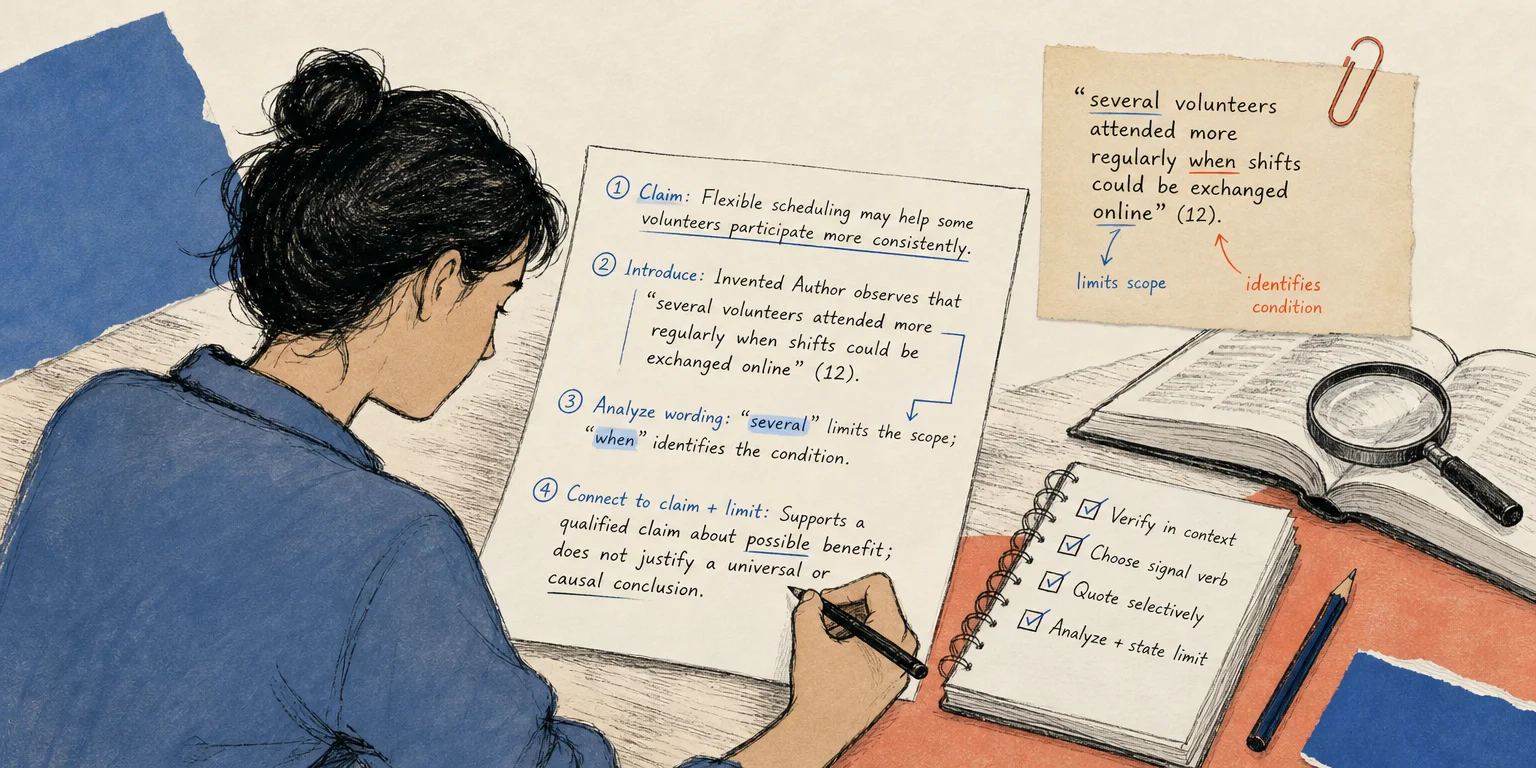
A quotation does not make an argument by itself. A useful evidence paragraph tells the reader what you claim, introduces a verified source accurately, presents only the words you need, and explains how those words support or limit the claim. If AI assists with the paragraph, use it to test structure or clarity—not to invent the quotation, source, or interpretation.
The UC Davis Source Integration Quick Guide, whose page footer says it was last updated December 1, 2025, explains that direct quotations should be integrated with the writer’s own words rather than left to stand alone. It shows signal-phrase and colon constructions, among other options. The practical lesson is not that every paragraph needs one fixed formula. It is that your sentence must establish a relationship between your claim and the source’s language.
Start with the claim, not the quotation
Before inserting evidence, write the point the paragraph needs to establish. A narrow claim gives you a standard for choosing a passage. Ask: which exact words bear on this point, and what do they establish?
If you cannot answer that question, the quotation may be relevant to the topic without supporting your particular claim. Recheck the source in context. If an AI tool supplied the wording or citation, locate the original before using it. When the exact phrasing matters, follow a separate quotation-protection workflow so an editing pass does not silently alter the source.
Choose a signal verb the source earns
A signal verb describes what the source is doing. Argues presents a reasoned position; observes reports something noticed; suggests is appropriately tentative; concludes indicates an endpoint reached from evidence. Do not upgrade suggests to proves merely to make your prose sound decisive.
Read beyond the selected line before choosing the verb. The surrounding passage may reveal a condition, uncertainty, or counterexample. Your introduction should preserve that scope. If the source is part of a counterargument, represent the position fairly before responding; the guide to writing a fair counterargument explains that distinct task.
Build the paragraph in four moves
- Make a focused claim. State what this paragraph contributes to the larger argument.
- Introduce the evidence. Identify the source as required and use a faithful signal verb or a complete lead-in.
- Quote selectively. Include the language needed for your analysis and cite it in the style your assignment requires. Citation and block-quotation rules vary, so consult that style rather than applying a universal threshold.
- Analyze the wording. Name the relevant word, distinction, assumption, or limitation. Then explain the reasoning that connects it to your claim.
“Analyze” does not mean repeating the quotation in simpler words. It means showing why a particular feature of the evidence matters and how far the evidence allows your argument to go.
Illustrative example: from dropped quotation to analysis
The source, quotation, and topic below are invented for teaching. They are not findings from a real study.
Dropped quotation:
The schedule improved volunteer participation. “Several volunteers attended more regularly when shifts could be exchanged online” (Invented Author 12).
The quotation is grammatically attached to the paragraph, but the writer has not explained its relevance. It also does not establish that participation improved for every volunteer or that online exchange caused the change.
Integrated evidence with analysis:
Flexible scheduling may help some volunteers participate more consistently. Invented Author observes that “several volunteers attended more regularly when shifts could be exchanged online” (12). The word “several” limits the scope of the observation, while “when” identifies the condition associated with the change. This evidence supports a qualified claim about possible benefit; it does not justify saying that online scheduling improves attendance universally or by itself.
The revised version does three jobs: it makes a limited claim, uses a reporting verb that does not overstate the fictional evidence, and explains how two details govern the conclusion.
Use AI assistance without surrendering the reasoning
You can ask an AI editor to flag a quotation that lacks a lead-in, list possible signal verbs for you to verify, or identify sentences where the analysis merely repeats the evidence. Treat those outputs as prompts for review. Compare every proposed change with the source, your claim, and your assignment’s AI-use policy.
Writers revising across languages can also use the ESL voice-preservation checklist to improve clarity without losing a deliberate distinction. The final test remains yours: can you point to the quoted words that support the claim, explain the connection in your own reasoning, and state the evidence’s limit? If not, revise the claim, choose better evidence, or add the missing analysis.
About Humanizer.help Editorial
Related Articles
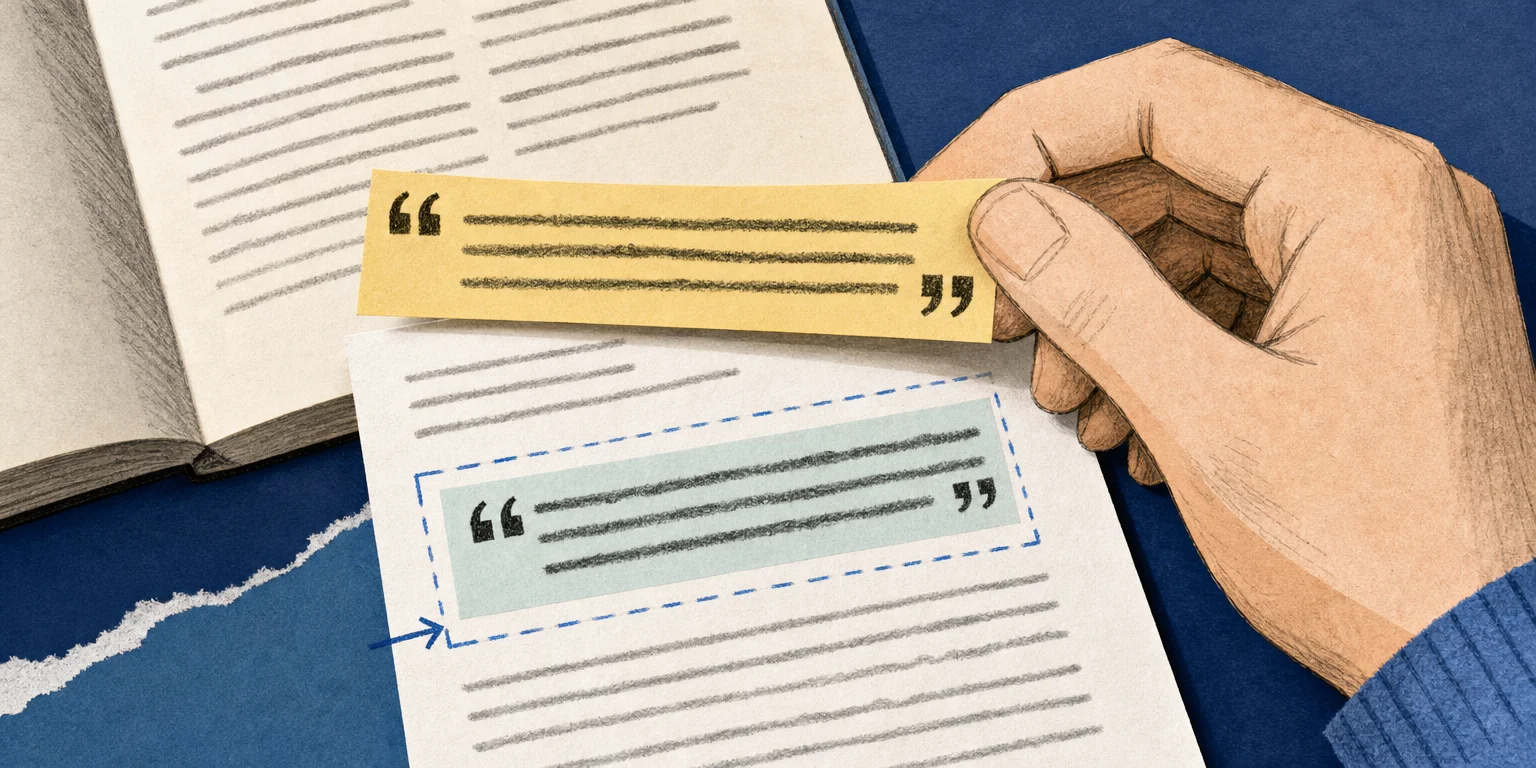
How to Protect Direct Quotations During AI Editing
Keep source wording intact through an AI-assisted style pass. Check omissions, brackets and context against a verified passage before submission.
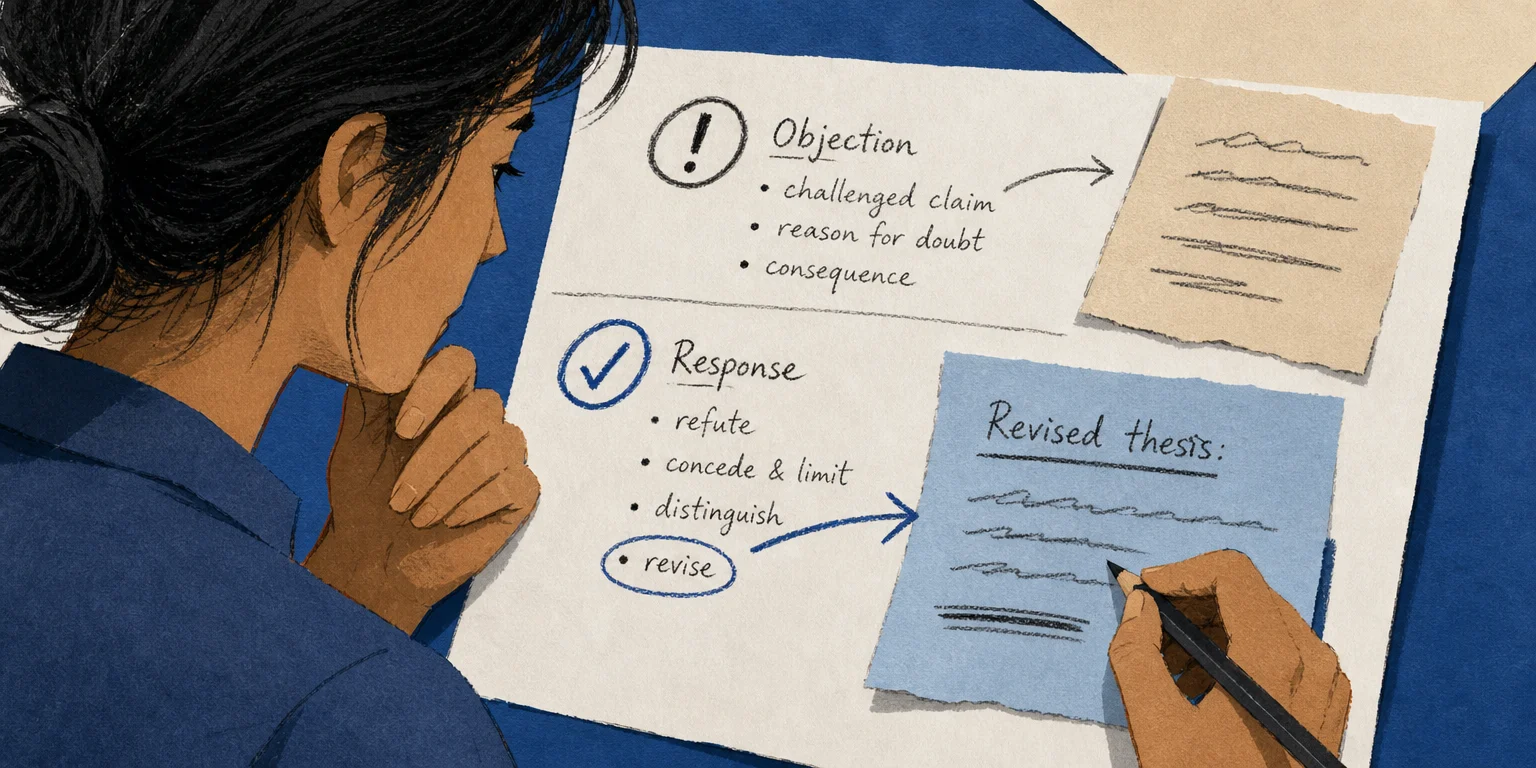
How to Write a Fair Counterargument in an AI-Assisted Essay
A counterargument should test your thesis, not make it look unbeatable. If an AI assistant produces an objection that is obviously foolish, vague, or easy to dismiss, the…

ESL Writing Help: Make AI-Assisted English Clear Without Erasing Your Voice
Improve rhythm, clarity, and sentence flow without flattening ESL voice into generic AI-sounding prose.