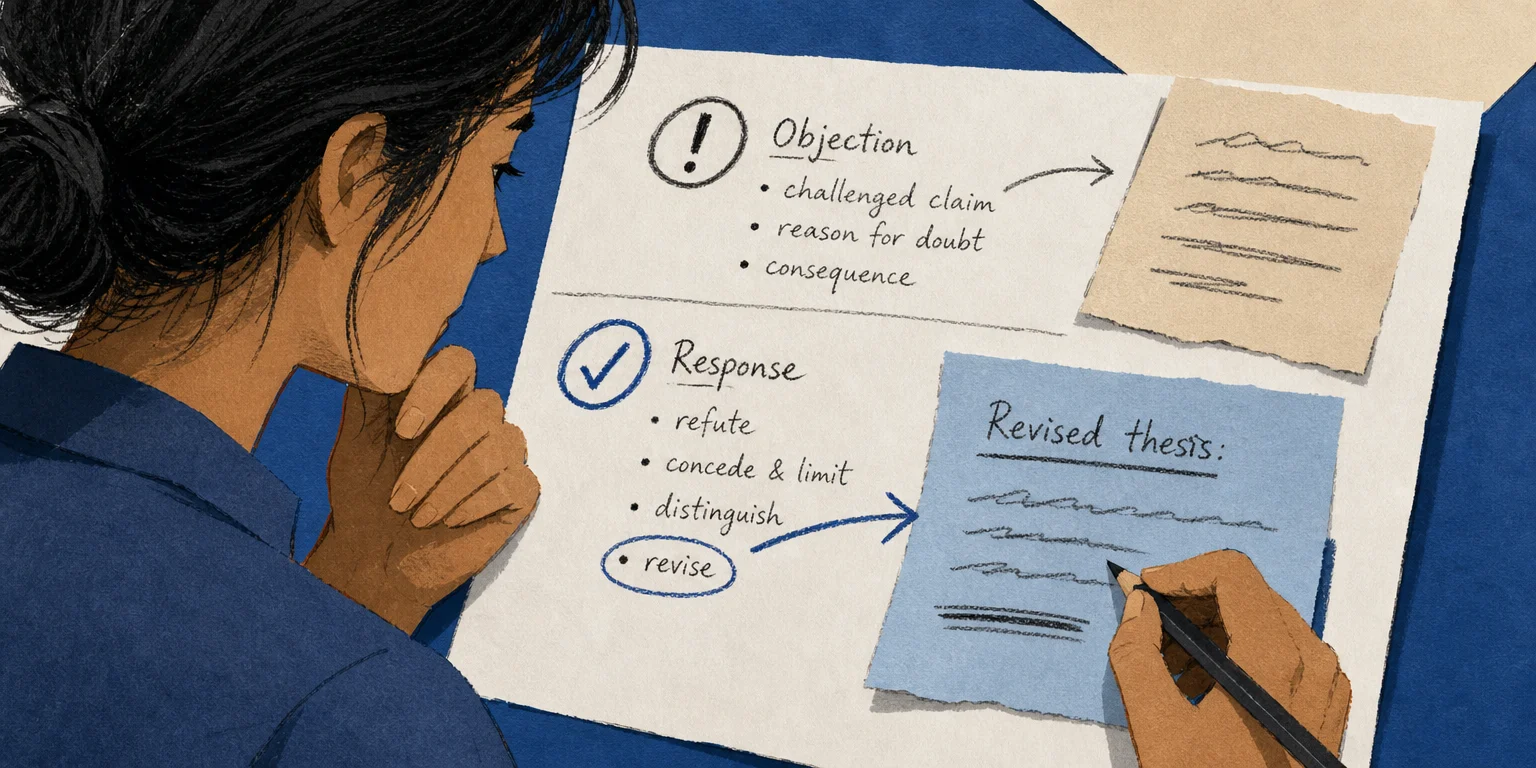
A counterargument should test your thesis, not make it look unbeatable. If an AI assistant produces an objection that is obviously foolish, vague, or easy to dismiss, the paragraph may sound decisive while doing no intellectual work. The better test is simple: could a thoughtful reader reasonably hold this position?
The Harvard College Writing Center explains that counterarguments can challenge a thesis, an assumption, a use of evidence, a key term, or a proposed solution. It also notes that a serious objection may lead a writer to refine the thesis rather than reject it entirely. That makes counterargument a revision method, not a decorative paragraph added at the end. See the Writing Center’s guide to counterargument.
First, identify what kind of objection you have
Before responding, label the objection as either attributed or imagined.
An attributed objection belongs to a real, verified source. Name that source, represent its reasoning accurately, and cite it at the point of use. Do not ask an AI tool to invent a scholar, quotation, or citation. If you cannot locate and read the source, do not present the objection as someone else’s position. The provenance steps in this guide to checking AI-assisted writing for accidental plagiarism can help keep sourced ideas separate from your own analysis.
An imagined objection is one you develop as a possibility: “A reader might object that…” It does not need a citation merely because it is an objection, but any factual premise inside it still needs evidence. Make clear that you are anticipating a position rather than reporting that a person or group actually holds it.
Build the strongest reasonable version
Ask the AI assistant for questions, not an opponent. For example: “Which assumption in this thesis is most vulnerable?” or “What evidence would make a reasonable reader hesitate?” Treat the output as brainstorming, then verify every factual claim yourself.
A useful objection has three parts:
- The challenged claim: identify the exact part of your argument under pressure.
- The reason for doubt: explain the competing evidence, interpretation, cost, or assumption.
- The consequence: show what would need to change if the objection were right.
Avoid assigning motives or traits to unnamed groups. A fairness check should compare evidence and reasoning, not stereotypes. The passage-level method in checking AI-assisted writing for bias is useful when an objection makes claims about people.
Choose a response that fits the evidence
Do not default to “however” followed by a repetition of your thesis. Choose among four responses:
- Refute: show that the objection relies on false evidence or invalid reasoning.
- Concede and limit: accept the part that is right, then explain its scope.
- Distinguish: show that the objection applies to a different case or definition.
- Revise: narrow or qualify the thesis because the objection reveals a real weakness.
A revision is not a failure. It is often the most honest result of testing a claim. Preserve the distinction you mean to make when polishing the English; writers working across languages may also find the voice-preservation checklist in this ESL writing guide helpful.
Illustrative example
The following example is invented for teaching.
Initial thesis: Universities should replace all timed exams with take-home projects because projects measure learning more accurately.
Weak objection: Some people just like exams.
This is vague and does not challenge the thesis’s claim about measurement.
Fair objection: Take-home projects may reveal sustained analysis, but they can also introduce unequal access to time, technology, and outside help. If those conditions vary widely, project performance may not provide a cleaner measure of individual learning.
Response by concession and revision: Take-home projects can assess sustained analysis better than a single timed response, but they should not replace every exam. Courses should combine projects with other assessments and design support that reduces differences in access.
The response changes the absolute claim because the objection exposes an overlooked condition. It does not pretend the original thesis survived unchanged.
Final counterargument check
Before keeping the paragraph, ask:
- Is this an attributed position or an imagined objection?
- Have I verified every source and factual premise?
- Would a reasonable critic recognize the objection as fair?
- Does my response refute, concede, distinguish, or revise?
- Did the objection force a meaningful change, or did I choose one I could dismiss?
- Does the revised thesis still say exactly what I can support?
Use AI assistance to expose pressure points and compare formulations, not to manufacture opponents or evidence. The finished paragraph remains your argument: its sources should be traceable, its concession proportionate, and its thesis no broader than the evidence allows.
About Humanizer.help Editorial
Related Articles

How to Check AI-Assisted Writing for Accidental Plagiarism
Audit AI-assisted writing for accidental plagiarism by tracing sources, finding patchwriting, choosing quotation or paraphrase, and checking attribution.

How to Check AI-Assisted Writing for Bias Before Publishing
Audit AI-assisted writing for unsupported group assumptions, unequal framing, missing agency, and biased language before you publish.

ESL Writing Help: Make AI-Assisted English Clear Without Erasing Your Voice
Improve rhythm, clarity, and sentence flow without flattening ESL voice into generic AI-sounding prose.