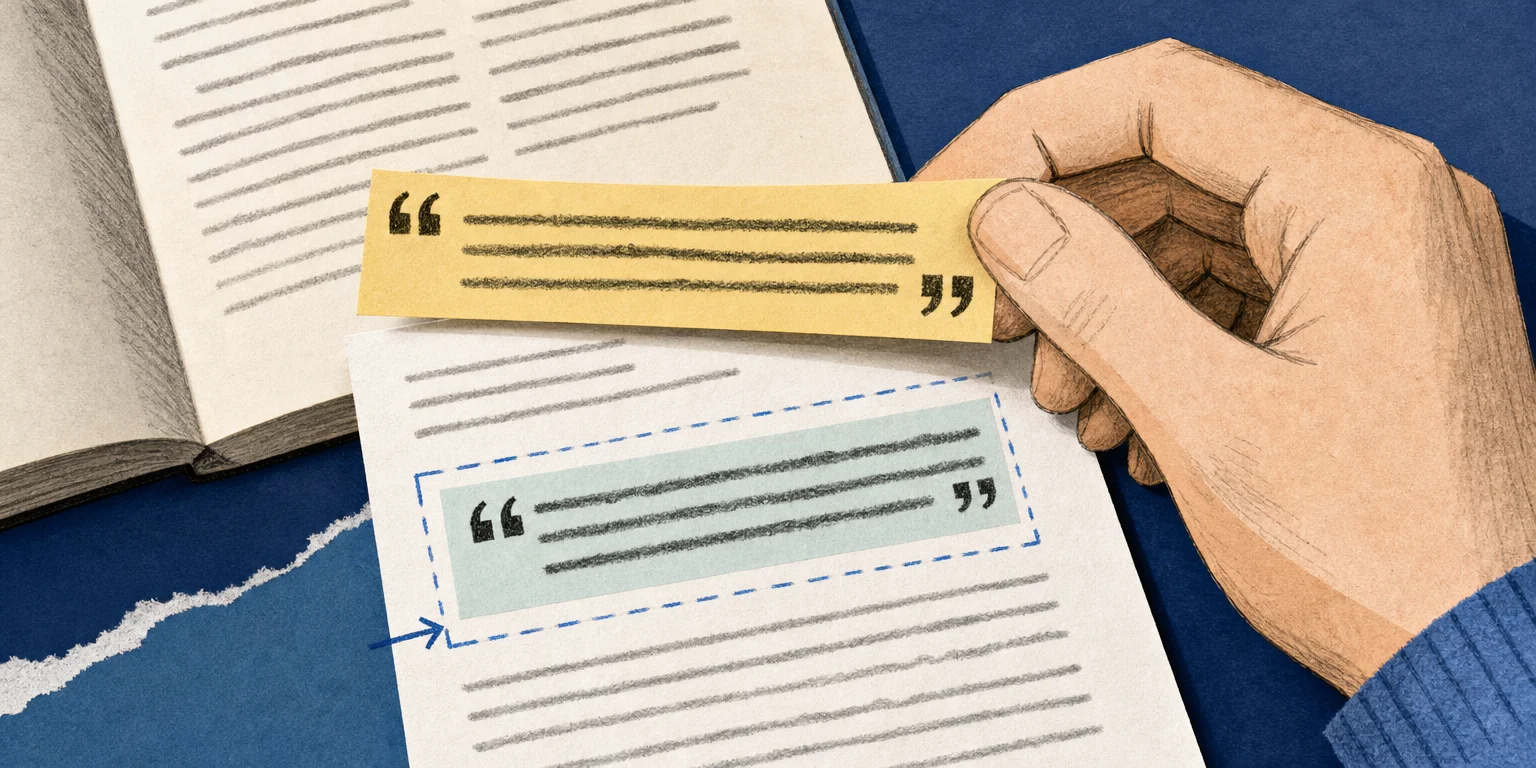
To protect direct quotations during AI editing, keep a verified copy of each passage, tell the editor which words are quoted, and compare the final quotation with the source after the rewrite. Improve the surrounding sentence freely within your argument; handle changes inside the quotation according to the required citation style, without changing the source's meaning.
A smoother quotation is not necessarily an accurate quotation. If a rewrite replaces the author's words with synonyms but leaves quotation marks around them, it is no longer presenting those words faithfully. A citation beside the sentence does not repair that mismatch.
Verify the passage before protecting it
Open the source you intend to cite and locate the passage itself. Keep enough surrounding text to understand the speaker, subject and qualification. Record the edition, page, paragraph or timestamp needed to find it again, according to your assignment or publication's requirements.
If the passage came only from an AI response, locate it independently before treating it as a quotation. The fact-checking workflow for AI-generated text covers that earlier source-verification task. This guide assumes you can already access and identify the source; its narrower task is protecting the quotation through an editing pass.
A copied passage can still be misleading if it omits a qualification from the surrounding discussion. Lund University's guidance on quoting emphasizes both the original context and the need to make interventions visible without changing the author's ideas.
Separate quoted words from the sentence around them
In your working copy, distinguish the source's language, your introduction to it, and your interpretation after it. Preserve those boundaries when moving text between tools. A block quotation is still quoted material even when its format does not use enclosing quotation marks.
Mark the editing boundary explicitly
For example, an editing instruction could say:
Revise only my introductory and explanatory sentences. Leave the identified direct quotation unchanged. List any suggested change inside it separately for my review against the source and required style.
This is a bounded request, not a guarantee that an AI tool will obey it. You still need a comparison after editing. Follow your institution's AI-use and source-sharing rules before supplying any material to a tool; protecting the wording does not grant permission to upload it.
Keep a separate verified copy
Save the original passage and its locator outside the text being rewritten. Otherwise, a revised paragraph can become the only copy you have, making the next review depend on the very output you need to check.
Your notes should make clear which text is the source's and which is your own. Do not let a drafting label such as “quote” turn an unverified sentence into evidence.
Compare words before judging fluency
After the edit, read the quoted span against the original word by word. Inspect negations, modal verbs, names, quantities and qualifying phrases especially carefully. “May help” and “helps” make different claims, even if a rewrite sounds more confident.
Then check the surrounding sentence. An introduction such as “The authors prove” can overstate a quotation that merely raises a possibility. Preserving every quoted word does not make your description of the passage accurate.
Harvard's guide to integrating sources distinguishes the writer's contribution from the source's language and cautions against omissions that change meaning. Use that distinction to review both the quoted passage and the claim you attach to it.
Review omissions and additions separately
An ellipsis indicates omitted material; brackets can identify an addition or adjustment. Neither mark is permission to make a source say something else. Exact conventions differ among styles, so consult the style required for your work.
Do not let an ellipsis erase the limitation
Here is an invented source passage for this editing exercise:
The pilot made scheduling easier for the volunteers, but it did not show whether the new process reduced the total workload.
This is fictional teaching material, not a real study or finding.
A misleading shortened version would be:
The pilot made scheduling easier ... the new process reduced the total workload.
The visible ellipsis does not make that version faithful. It has removed the negative finding and linked surviving words into a claim the source did not make. Restore the relevant qualification, or choose a shorter passage whose meaning you can represent accurately in context.
The ANU guide to quoting warns against removing text in a way that misrepresents the original. Check what the omitted material did, rather than merely confirming that dots are present.
Do not use brackets to hide a rewrite
A bracketed clarification can identify an otherwise unclear reference when the required style allows it. It should not replace a tentative statement with a stronger one, introduce an unsupported name, or add your conclusion to the author's words.
UW–Madison's quoting guidance discusses marking omissions and additions. If the quotation needs extensive replacement to fit your sentence, rewrite your sentence instead. Harvard likewise cautions against overusing bracketed substitutions.
Choose a quotation or a paraphrase deliberately
When the author's exact language matters to your analysis, keep an accurate quotation and build your sentence around it. When you need only the idea, consider a properly attributed paraphrase that you write and verify as a paraphrase. Do not leave quotation marks around a rewritten version merely because it came from a quoted starting point.
The source-use audit for AI-assisted writing explains the broader distinction among quotations, paraphrases and borrowed ideas. Here, the final decision is simpler: can the reader tell which words are presented as exact, and can you trace those words to the source?
A paraphrase still needs appropriate attribution. Removing quotation marks is not enough if the wording or structure remains too close to the source, and it does not establish that the paraphrase preserves the meaning.
Finish with a small quotation record
For each quoted passage, keep the verified text, source locator, final quoted span, and a note explaining any omission or bracketed intervention. Mark unresolved differences for correction before submission.
Check the rendered or exported document as well as the editor view. Confirm that block-quote formatting, quotation marks, citation placement and any required omission marks survived. If another style pass changes the paragraph later, compare the quotation again.
The completed artifact is a passage whose exact language, permitted interventions and context are inspectable. A fluent paragraph and a matching bibliography alone do not establish those things.
FAQs
Can I silently fix grammar inside a quotation?
Do not treat a grammar suggestion as permission to rewrite the source. Check the required style for permitted interventions. Often the clearer solution is to change your surrounding sentence or choose another passage rather than alter the quoted wording.
Does a citation make an altered quotation acceptable?
No. The citation identifies a source; it does not make rewritten words an exact representation of it. Restore the quotation or deliberately produce and verify an attributed paraphrase.
Must every quotation use quotation marks?
No. Longer passages may use block-quote formatting under the applicable style. They still require accurate wording, context and attribution. Length thresholds and formatting rules depend on the style you are required to follow.
About Humanizer.help Editorial Team
The Humanizer.help editorial team writes practical AI writing guides for students, ESL writers, and academic drafts that need clearer, more natural English.
Related Articles

How to Fact-Check AI-Generated Text Before You Use It
Use a source-first workflow to verify claims, citations, quotations, dates, and numbers in AI-assisted drafts before publishing or submitting them.

How to Check AI-Assisted Writing for Accidental Plagiarism
Audit AI-assisted writing for accidental plagiarism by tracing sources, finding patchwriting, choosing quotation or paraphrase, and checking attribution.