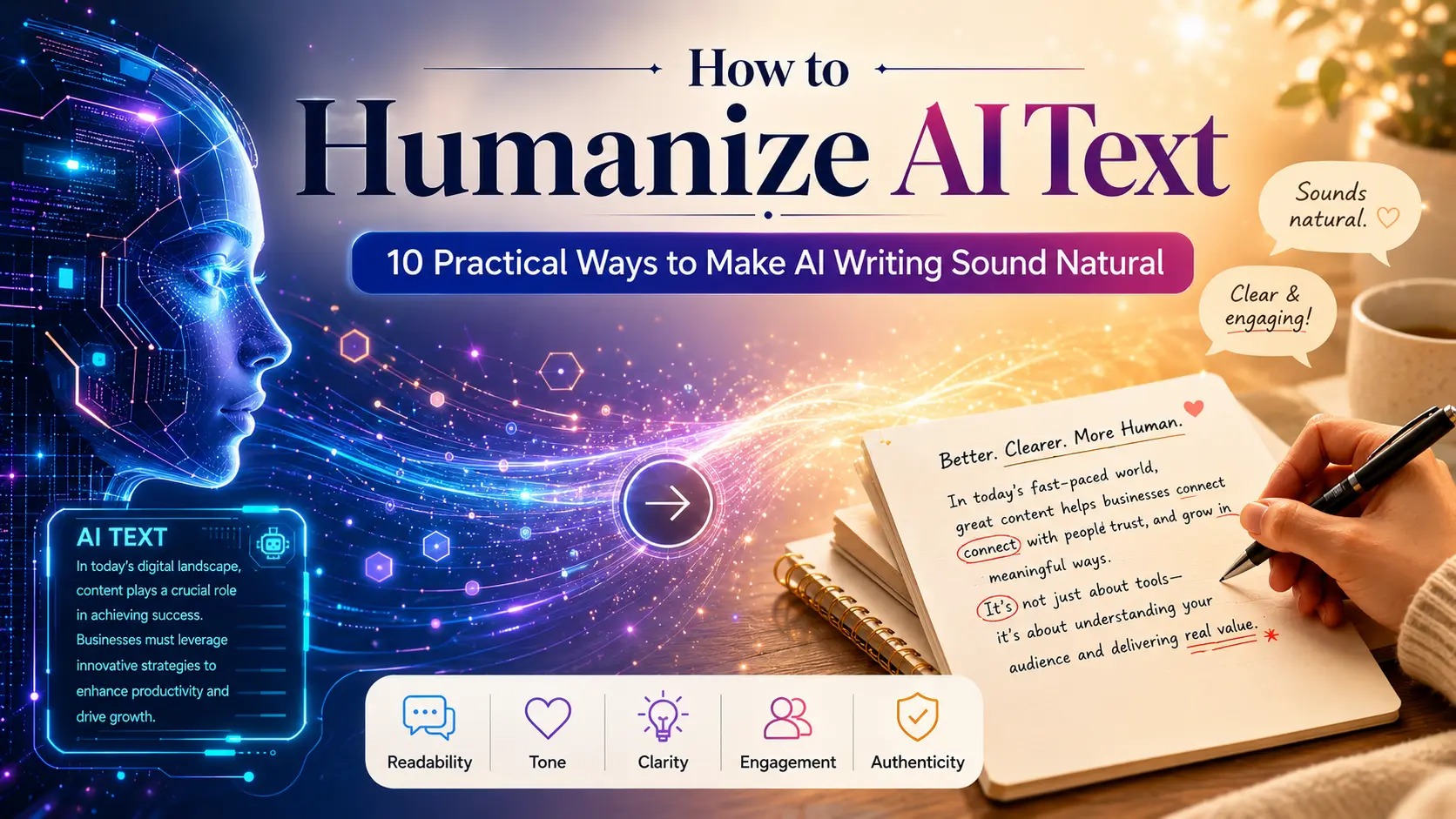
An AI humanizer is a tool or editing process that rewrites AI-generated text so it sounds more natural, conversational, and human-written. It changes sentence structure, word choice, tone, rhythm, and flow to reduce robotic or repetitive writing patterns.
- A good AI humanizer improves communication; it does not replace original thinking.
- Strong humanizing preserves meaning while improving rhythm, tone, and clarity.
- Detection bypass promises are risky because AI detectors can be wrong in both directions.
- Students should review school rules, privacy terms, and final accuracy before using any tool.
What does an AI humanizer do?
An AI humanizer works like an editing assistant that adjusts how a sentence feels without changing the main meaning. AI-generated writing often sounds polished but predictable, with formal transitions, generic phrases, repeated sentence patterns, and broad claims.
A humanizer usually rewrites awkward sentences, softens robotic tone, improves sentence flow, varies sentence length, and adjusts style for a specific audience.
AI-like sentence vs humanized sentence
This article aims to provide users with information regarding effective productivity strategies.
This article explains practical ways to get more done without feeling overwhelmed.
How do AI humanizers work?
AI humanizers analyze AI-written text and rewrite it with more natural structure, tone, and word choice. Most tools use natural language processing, language models, paraphrasing systems, or rule-based editing patterns.
A basic humanizer may only replace words with synonyms. A stronger tool restructures sentences, changes rhythm, removes unnecessary phrases, and improves clarity.
The best output still requires human review because automated rewriting can change nuance, remove important details, or create meaning drift.
What AI humanizers often adjust
Why does AI writing sound robotic?
AI writing sounds robotic when it uses predictable wording, repeated structure, and vague statements. Many AI drafts are grammatically correct, but they do not always sound personal, specific, or context-aware.
Common patterns include repeated sentence openings, overused transitions, generic conclusions, vague claims, and overly balanced structure. Human writing usually mixes short, medium, and long sentences and adds context from real situations.
A good AI humanizer improves the surface of the writing. A good human editor improves the thinking behind the writing.
AI humanizer vs paraphrasing tool vs grammar checker
These tools overlap, but they solve different writing problems.
| Tool | Main function | Best for | Limitation |
|---|---|---|---|
| AI humanizer | Makes AI text sound more natural and human-like | AI drafts, blogs, emails, essays, and study writing | May change meaning if unchecked |
| Paraphrasing tool | Rewrites text with different wording | Rewording repeated or copied phrasing | May not improve voice or flow |
| Grammar checker | Corrects grammar, spelling, punctuation, and clarity | Final proofreading | Does not fully humanize style |
| Human editor | Adds judgment, examples, structure, and accuracy | High-stakes writing | Slower than automated tools |
When should you use an AI humanizer?
Use an AI humanizer when an AI-assisted draft is accurate but sounds stiff, repetitive, or unnatural. The tool is most useful after the main ideas are already clear.
For student and academic-adjacent writing, it can help adjust tone, improve readability, and make sentences easier to review. For SEO content, it can improve readability and engagement, but rewriting alone does not make content helpful or authoritative.
When should you avoid using an AI humanizer?
Avoid using an AI humanizer when the goal is to hide authorship, bypass policy, or misrepresent the source of work. Students need to follow school AI policies. Sensitive, legal, medical, client, or confidential material should not be pasted into random tools without checking privacy terms.
Can humanized AI text be detected?
Humanized AI text can still be detected or flagged by AI detection tools. No AI humanizer can guarantee that text becomes undetectable.
Detectors such as Turnitin, GPTZero, Originality AI, and similar systems estimate whether text appears AI-written. They do not prove authorship with perfect certainty. The safer question is not whether a tool can bypass detection; it is whether the text is clear, accurate, honest, and appropriate for its context.
Manual workflow to humanize AI text
Manual humanizing example
AI tools can be beneficial for improving productivity in various professional environments.
AI tools help teams draft emails, summarize notes, and organize routine writing tasks faster.
What makes a good AI humanizer tool?
Are AI humanizers useful?
AI humanizers are useful when they improve readability, tone, flow, and clarity. They are less useful when they only replace words or promise to defeat AI detectors.
The strongest results come from a human-in-the-loop workflow. AI can draft, rewrite, and suggest. A person verifies facts, improves examples, adjusts tone, and decides whether the final text is honest and useful.
FAQs about AI humanizers
Is using an AI humanizer cheating?
Using an AI humanizer is not automatically cheating. It depends on the rules of the context. Using one to improve clarity may be acceptable. Using one to hide AI-generated work or violate school policy creates ethical risk.
Is there a free AI humanizer?
Many AI humanizers offer free versions. Free tools usually have limits on word count, rewrite depth, tone control, or privacy features.
Is manual editing better than an AI humanizer?
Manual editing is better for accuracy, originality, nuance, and judgment. AI humanizers are faster for first-pass rewriting.
Improve clarity without losing your meaning
Use Humanizer.help as an editing layer, then review the final version yourself before submitting or publishing.
About Humanizer.help Editorial Team
The Humanizer.help editorial team writes practical AI writing guides for students, ESL writers, and academic drafts that need clearer, more natural English.