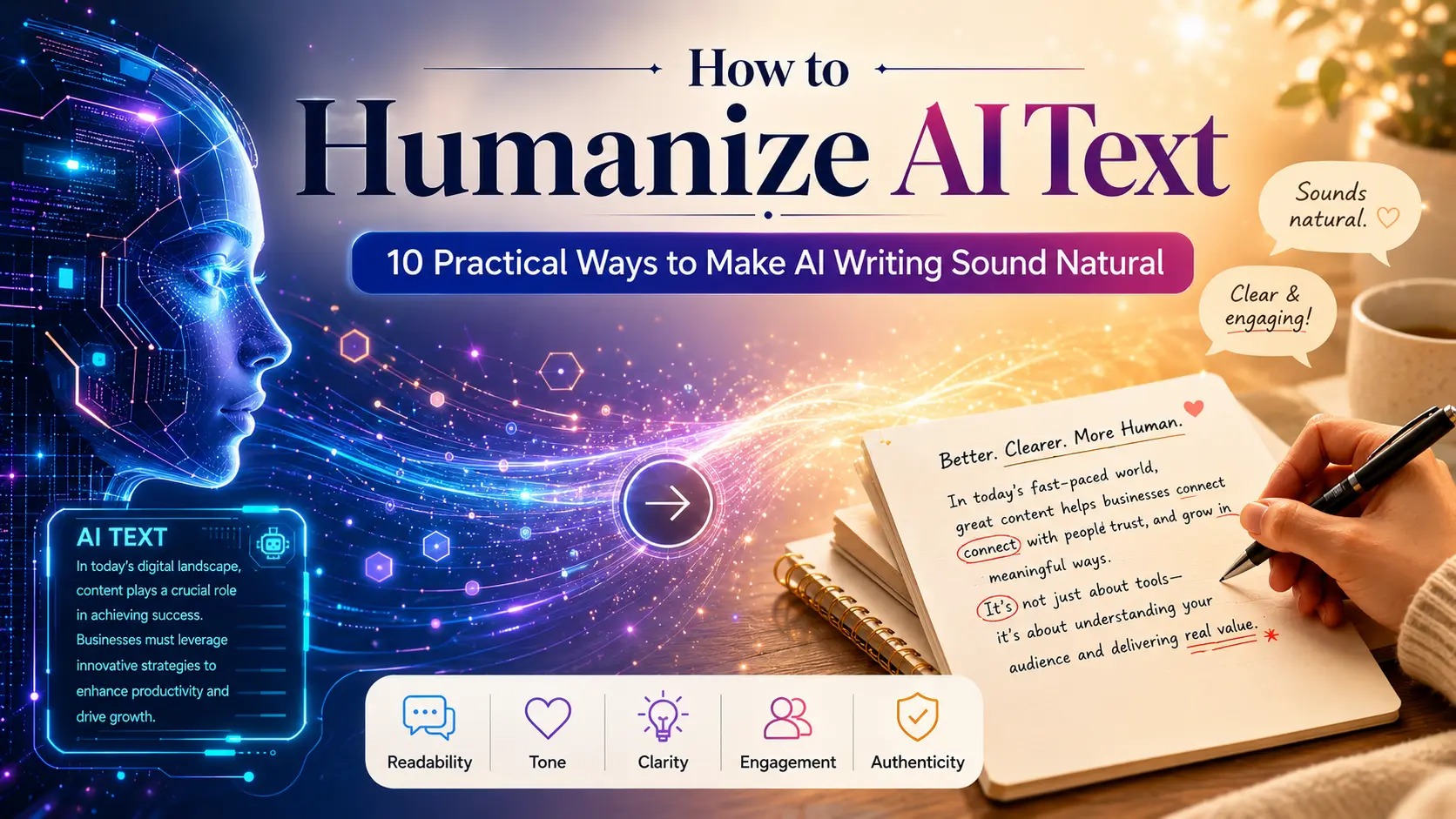
To humanize AI text means rewriting AI-generated content so it sounds natural, specific, context-aware, and useful for real readers while preserving the original meaning. It is not simple synonym replacement. It combines sentence variation, tone adjustment, active voice, clearer wording, examples, transitions, factual checking, and human editorial judgment.
- Start with the message of each paragraph before changing words.
- Replace vague claims with concrete nouns, clear verbs, and examples.
- Use tools as an editing layer, then review accuracy, originality, and tone yourself.
- Avoid guaranteed bypass claims and write for clarity, trust, and policy-aware use.
A practical workflow for natural AI writing
The best way to humanize AI text is to use a structured workflow. Start with the meaning, improve rhythm, replace vague claims with details, adjust tone, use stronger verbs, add human perspective, remove robotic transitions, and review the final version manually.
Prompts and AI humanizer tools can support this process. They cannot replace accuracy, originality, and responsible editing.
10 steps to humanize AI text
Start with the meaning, not the words
Identify what each paragraph is trying to say before you rewrite it. This protects the original message and reduces semantic drift.
Many weak humanizers only replace words with synonyms. That can make text different without making it better.
Read the AI draft once without editing. For each paragraph, ask what it is trying to say, then preserve that point while improving the language.
Vary sentence length and structure
Mix short, medium, and long sentences so the paragraph has rhythm instead of a repeated AI pattern.
AI tools can improve writing. AI tools can save time. AI tools can help users create content. AI tools can support many professional tasks.
AI tools can save time, but the first draft usually needs editing. The goal is not to sound perfect. The goal is to sound clear.
Replace generic phrases with specific details
Generic claims such as "improve efficiency" sound polished but thin. Add who, what, and what outcome the sentence actually means.
This strategy helps businesses improve efficiency.
This strategy helps small teams turn meeting notes into follow-up emails in less time.
Adjust the tone for the reader
A blog post can sound conversational. An academic paper needs formal language and careful claims. A landing page needs benefit-driven language. Define the audience before rewriting.
Use active voice and stronger verbs
Active voice makes writing shorter and easier to follow. Replace abstract nouns and weak verbs with clear subjects, useful verbs, and specific objects.
The report was generated by the system to provide insights.
The system generated the report to show key insights.
Add human perspective, examples, or micro-stories
Add useful context, not fake personal stories. A scenario, observation, or reader-focused action can make the text feel authored instead of assembled.
Writers may benefit from reviewing their drafts carefully.
After the first draft, read the paragraph as if you are the customer, not the writer. Awkward lines become easier to spot.
Remove robotic transitions and repetition
Cut filler transitions such as "furthermore" or "it is important to note" when they do not show a real relationship between ideas.
Furthermore, businesses can use this tool to improve productivity.
Teams can also use this tool to finish routine writing faster.
Use contractions and natural language carefully
Contractions can make blog posts and emails more relaxed, but formal academic or legal writing may need a stricter tone.
You do not need to rewrite every sentence.
You don't need to rewrite every sentence.
Use prompts before you rewrite
A clear prompt defines audience, tone, sentence style, and editing goal. Better prompting reduces robotic output before the editing stage.
Use AI humanizer tools as an editing layer
Humanizer tools can improve tone, readability, and sentence flow when the draft is already accurate. Compare tools by meaning preservation, privacy, tone control, rewrite quality, and editing flexibility.
Prompt template to humanize AI text
Rewrite the following text for [audience]. Keep the original meaning. Use a [tone] tone. Vary sentence length. Remove generic AI phrases. Use active voice. Add specific examples where appropriate. Do not overstate claims. Keep the text clear and natural.
Editing test for robotic AI text
Can humanized AI text still be detected?
Humanized AI text can still be flagged by AI detection tools. Humanizing may reduce robotic patterns, but it does not guarantee that detectors will classify the text as human-written.
AI detectors estimate probability. They do not prove authorship with perfect certainty. A detector may flag human-written text as AI-generated, and it may miss AI-generated text that has been rewritten.
The safer approach is to humanize for clarity, accuracy, and usefulness. Add original examples, check facts, follow school or workplace policies, and use disclosure when required.
Manual editing vs prompts vs AI humanizer tools
Each method improves AI text in a different way. The strongest workflow combines all three.
| Method | Best for | Watch out for |
|---|---|---|
| Manual editing | Accuracy, originality, examples, voice, and judgment | Takes more time for long drafts |
| Prompts | Improving the first draft before editing begins | Still needs review for facts and tone |
| AI humanizer tools | Fast tone adjustment, readability, and sentence polish | May create meaning drift or remove context |
Responsible student use
Use AI humanizing to improve clarity and flow, not to hide responsibility. Preserve meaning, add your own examples, check facts, and follow school policy before submitting any AI-assisted draft.
FAQs about humanizing AI text
How do I make AI text sound human?
Make AI text sound human by varying sentence structure, adding specific examples, adjusting tone, removing robotic transitions, using active voice, and reviewing the final draft manually.
What prompt can I use to humanize AI text?
Use a prompt that defines the audience, tone, and editing goal. Ask the AI to preserve meaning, vary sentence length, remove generic phrasing, and improve natural flow.
Can ChatGPT humanize AI text?
ChatGPT can rewrite AI text in a more natural tone. The result still needs human review for accuracy, originality, voice, and context.
Why do AI humanizers not work sometimes?
AI humanizers fail when they only replace words, over-edit the sentence, remove context, repeat generic patterns, or change the original meaning.
Keep learning
Review a draft before you submit
Paste a paragraph, improve natural flow, and check whether the rewrite still preserves your meaning.
About Humanizer.help Editorial Team
The Humanizer.help editorial team writes practical AI writing guides for students, ESL writers, and academic drafts that need clearer, more natural English.