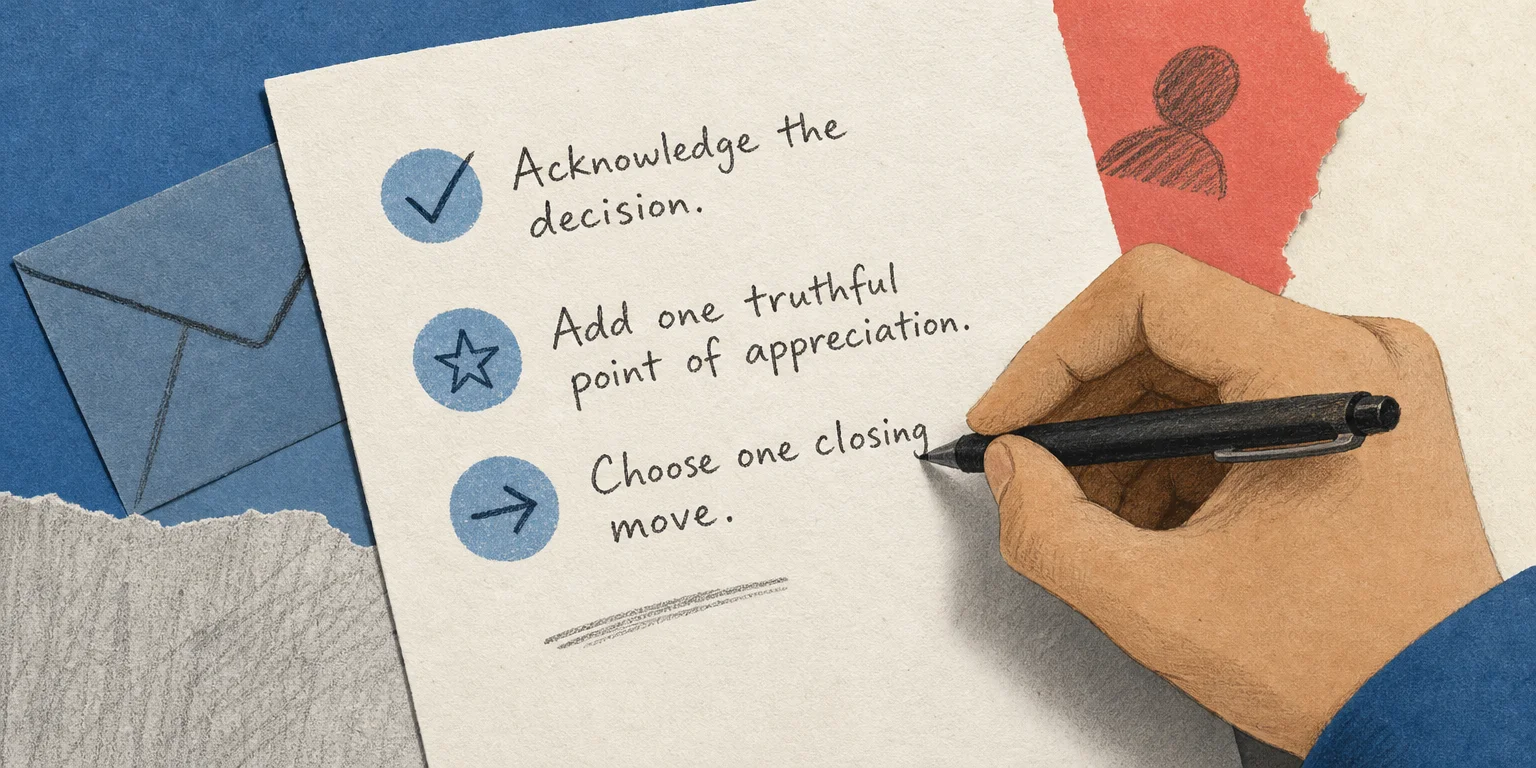
A job rejection reply does not need to turn disappointment into enthusiasm. Its job is simpler: acknowledge the decision, thank the people involved where that feels genuine, and make only the next-step request or offer you actually mean.
The first decision is whether to reply at all. A brief automated rejection after an application may not call for an answer. A personal note after one or more interviews gives you more reason to respond, especially if you want to thank the interviewer, request feedback, or express interest in a genuinely suitable future role. Grammarly’s guide, updated May 26, 2026, also treats a reply as optional in low-contact or automated cases: https://www.grammarly.com/blog/emailing/how-to-reply-to-a-job-rejection-email/
Choose one purpose before drafting
Write a private one-line note completing this sentence: “I am replying to…” Your answer might be “thank the panel for a substantive interview,” “ask whether feedback is available,” or “leave the door open for a specific kind of role.” If the only honest answer is “because I feel I should,” a short acknowledgment—or no reply—may be enough.
This purpose check prevents a polished draft from making commitments you do not mean. “I would love to be considered for any future opportunity” is broad. If you would only consider roles in a particular field, location, or level, say that or omit the sentence. The same principle appears from the opposite side in Humanizer.help’s guide to editing an AI-drafted refusal email: future offers should reflect a real decision, not decorative politeness (https://www.humanizer.help/blog/edit-ai-drafted-refusal-email).
Use a three-part reply
Most useful replies can be built from three parts:
- Acknowledge the decision. “Thank you for letting me know about the decision on the [role] position.” Do not write as if the hiring decision is still under negotiation unless the employer has invited that discussion.
- Add one truthful point of appreciation. Mention a conversation, project, or insight only if it happened and mattered to you. A specific detail can make the note sound like yours; invented enthusiasm cannot.
- Choose one closing move. End with a low-pressure feedback request, a bounded statement of future interest, or a simple good wish. You do not need all three.
Adapt the message to the amount of contact
The examples below are illustrative and invented. They are not messages from real applicants and have not been tested for response rates.
After an automated or early-stage rejection
Hi [Name],
Thank you for the update on the [Role] position. I appreciate your consideration.
Best, [Name]
This version does not pretend that a relationship developed when there was little or no direct contact. If the message came from an unmonitored address, there may be no practical reason to send it.
After a substantive interview
Hi [Name],
Thank you for letting me know about the decision. I appreciated our discussion of [truthful, specific topic], especially [brief detail].
If a future [specific type of role] is a closer match, I would be glad to hear from you. I wish you and the team well.
Best, [Name]
Keep the specific detail short. The reply is not a second cover letter, and it should not restate your qualifications in an attempt to reverse the decision.
When you want feedback
Hi [Name],
Thank you for the update and for the time the team spent with me during the interview process.
If you are able to share any feedback that could help me prepare for similar roles, I would value it. I understand if your process does not allow that.
Best, [Name]
A feedback request is a request, not an obligation. Avoid repeated follow-ups if the employer does not respond.
Remove language that changes your meaning
Before sending, check every sentence for a claim or commitment. Delete praise you cannot support, future interest you do not feel, and emotional detail you do not want to disclose. Check the role title, recipient name, interview detail, and email thread. Then read only the first and last sentences: together, they should accept the decision and close on the same terms.
A good rejection reply is not the warmest possible message. It is the shortest message that accurately reflects the contact you had, the appreciation you feel, and the next step—if any—you genuinely want.
Related reading: How to Edit AI Writing with an Editorial Style Sheet.