To edit an AI-drafted refusal email, state exactly what you are declining, keep the reason truthful, and remove any alternative or future commitment you have not agreed to provide. A considerate message should let the recipient distinguish a final no from a proposed delay or a smaller offer of help.
“Perhaps we can revisit this next week” sounds friendly. If you have already decided not to take the task, it can also invite a follow-up you never intended. Check the decision before polishing the tone.
Decide what kind of answer you are sending
Write the answer in a private note: declining the whole request, declining the requested timing, or offering a narrower contribution. If you have not made a decision, the message is an acknowledgment or a request for more information, not a refusal.
Use the guide to acknowledging a request before review for that earlier stage. The task here begins after the sender knows what they can and cannot accept.
A reply to a manager assigning required work may need a discussion of priorities rather than a unilateral refusal. This article covers ordinary professional requests within the sender's authority to accept or decline. It does not determine employment obligations, formal appeal rights, or organizational policy.
Name the boundary precisely
Identify the requested task or deliverable. “I can't help with this” can leave the scope unclear if the incoming email contains several requests. A more specific sentence might say, “I can't review the full report this week.” That declines a task and a time window; it does not automatically decline every possible contribution forever.
Distinguish a no from a rescheduling offer
If only the date is unsuitable, a later date can be a real counteroffer. If you cannot commit to doing the task at all, “not this week” may be incomplete. Do not let an AI draft add “try me next week” unless you genuinely want the request reopened then.
The Open University's guidance on saying no at work distinguishes constructive refusals and qualified availability, including alternatives offered with the other person's agreement. The practical editing point is to make the actual limit visible.
Distinguish a smaller offer from accepting ownership
“I can share the existing checklist” is not “I can run the review.” A smaller offer should name what it includes. If a deadline, number of documents or revision round matters, confirm it before adding it to the email.
If you are offering to ask someone else, do not write as though that person has already accepted. You can decline your own participation without assigning the task to a colleague.
Keep the explanation short and supportable
Give the recipient enough context to understand the answer when appropriate. Do not invent a policy, a supervisor's decision or an emergency to make the refusal sound more persuasive. You also do not need to include private details simply because a draft fills a paragraph with reasons.
The British Council's refusal-email guidance emphasizes considering the audience, giving an objective explanation, and suggesting genuine alternatives. Apply those principles to facts you can confirm. They do not guarantee that the recipient will accept the decision happily.
A sentence such as “My current delivery commitments leave no capacity for a full review” is usable only if it accurately describes your situation. If the reason cannot be shared, a bounded statement of availability may be enough. Follow any applicable organizational process for decisions that require a formal explanation.
Work through a fictional refusal
The following example is invented teaching material. No email was sent, and no response-rate test was performed.
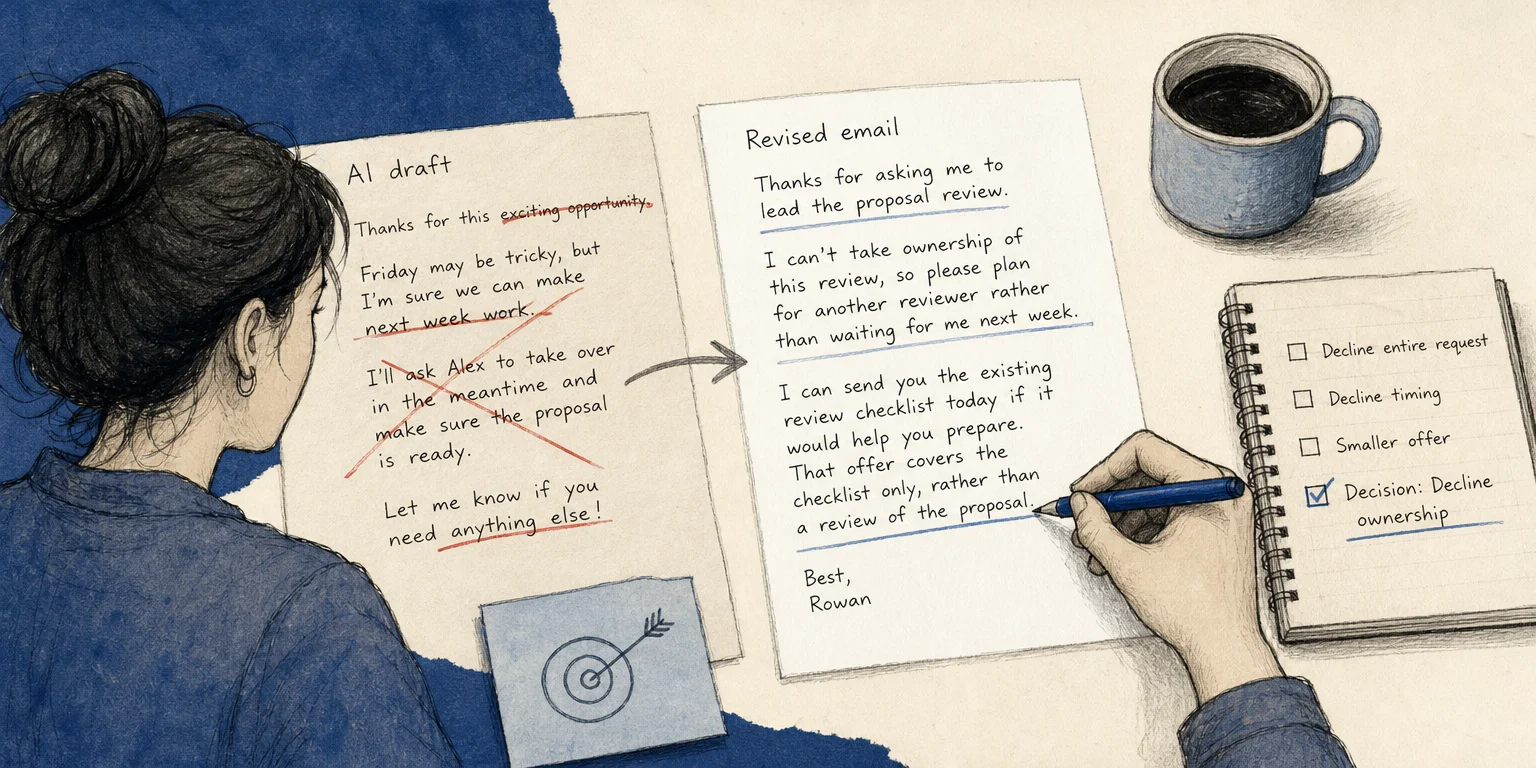
Sender's decision: A colleague asks Rowan to lead a complete proposal review by Friday. Rowan cannot take ownership of the review and has not committed to a later date. Rowan can send an existing review checklist today. No replacement reviewer has been contacted.
Unreviewed AI draft:
Thanks for this exciting opportunity. Friday may be tricky, but I'm sure we can make next week work. I'll ask Alex to take over in the meantime and make sure the proposal is ready. Let me know if you need anything else!
The draft sounds encouraging but changes the decision. It treats a declined role as a scheduling problem, implies a future commitment, assigns Alex without agreement, and promises a finished proposal.
A revision that matches the fictional decision could read:
Subject: Proposal review request
Hi Sam,
Thanks for asking me to lead the proposal review. I can't take ownership of this review, so please plan for another reviewer rather than waiting for me next week.
I can send you the existing review checklist today if it would help you prepare. That offer covers the checklist only, rather than a review of the proposal.
Best, Rowan
The last offer is appropriate only because the brief confirms the checklist and Rowan's ability to send it. If neither exists, remove it. There is no requirement to invent an alternative in order to make a refusal polite.
Choose the order for this reader
A routine request from a colleague who values brevity may need a brief acknowledgment followed by the decision. A sensitive message may need some context first. Both approaches still need an unmistakable answer.
The negative-news chapter in Communication at Work describes direct and indirect approaches and situations where getting to the point is appropriate. Do not turn either pattern into a rule for every relationship. A warm opening should not imply acceptance that the rest of the message withdraws.
For a subject line, name the request or topic so the reply can be found again. UW–Madison's email guidance recommends a detailed, accurate subject for negative news without using a blunt rejection as the subject itself. A neutral subject such as “Proposal review request” can serve that purpose.
Audit every sentence that creates new work
Before sending, highlight “I will,” “we can,” “next time,” “I'll introduce you,” and open-ended offers such as “anything else.” Ask what each sentence commits you or another person to do.
Remove a promise that is merely decorative. Keep an offer that is real and useful, with its limits intact. If the reply concerns a customer case rather than a discretionary colleague request, use the customer-support reply review workflow to check the approved actions and case facts as well.
Finally, read only the decision and closing. Do they say the same thing about what will happen next? A clear refusal followed by an unlimited offer can undo the boundary you just established. Correct that conflict before checking names, attachments and the final sign-off.
FAQs
Do I need to offer another person or a later date?
No. Offer an alternative only when it is genuine, appropriate and within your authority. Ask a colleague before implying that they will take on the work. Suggest a later date only when you intend to consider or accept that later commitment.
Should I remove every apology?
No. An apology may suit the relationship or situation. Check whether it acknowledges inconvenience without replacing the answer or implying fault that you did not mean to accept. Repeated apologies rarely clarify the scope of the decision.
What if I have not decided yet?
Say that the request is still under review and give only a next step you can actually take. Do not send a final refusal or a likely acceptance simply because a writing tool supplied one.
About Humanizer.help Editorial Team
The Humanizer.help editorial team writes practical AI writing guides for students, ESL writers, and academic drafts that need clearer, more natural English.
Related Articles
How to Acknowledge a Request Before You Can Review It
A polished acknowledgment can accidentally approve a request you have only received. When a colleague sends a design proposal and asks for feedback by Friday, you can confirm its a

How to Review AI-Generated Customer Support Replies
Check an AI-drafted support reply against the customer's message, verified ticket facts, approved actions, and a realistic next step.