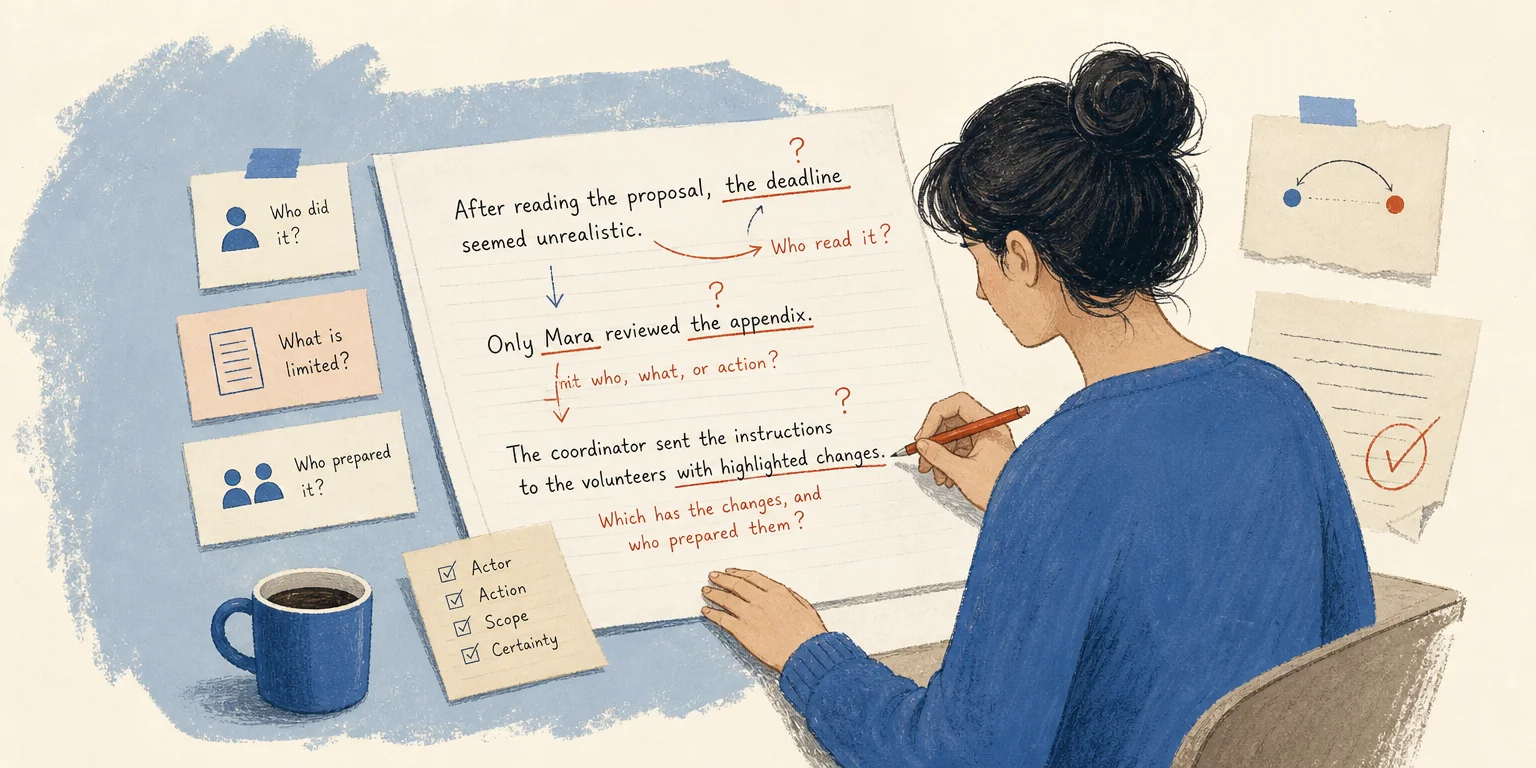
To fix misplaced modifiers in AI writing, identify exactly what each descriptive word or phrase is meant to modify. Put it where that relationship is clear, or rewrite the sentence as a complete clause. If two readings remain plausible, confirm the intended meaning before accepting a fluent rewrite.
Moving a few words can change who performed an action, who receives something, or what a restriction applies to. The aim is to recover the intended relationship, not to make every sentence follow the same word order.
Identify the detail and its intended target
A modifier adds information to another element in a sentence. It may be one word, such as “only,” or a longer phrase, such as “after reading the draft.” Start by underlining the detail and drawing a connection to the person, action or thing it describes.
Utah Valley University's modifier guide recommends placing modifiers close to what they modify. Use closeness as a practical check, not a rule that every descriptive phrase must sit immediately beside a noun. Context and sentence structure also establish relationships.
Ask a concrete question: Who was reading? Which document was marked? What is limited to one person or one action? If the source notes do not answer that question, an editor should not invent the answer.
Check introductory phrases for a missing actor
Consider this invented sentence:
After reading the proposal, the deadline seemed unrealistic.
A deadline cannot read a proposal. The sentence leaves the reader of the proposal unstated. If the writer confirms that Mara read it, one repair is:
After reading the proposal, Mara thought the deadline was unrealistic.
Another repair gives the opening its own subject:
After Mara read the proposal, the deadline seemed unrealistic to her.
Purdue OWL's dangling-modifier guidance describes both approaches: identify the appropriate actor in the main clause, or make the introduction a complete clause. The name in the revision must come from the intended meaning, not the writing tool's preference.
Avoid repairing grammar by inventing a decision
“The team rejected the deadline” is a different claim from “Mara thought the deadline was unrealistic.” The first adds an organizational decision. When fixing the opening, preserve the distinction between a person's reaction and an approved action.
For the same reason, do not add “because” unless a causal relationship is intended. A phrase that reports when something happened does not necessarily explain why it happened.
Test the scope of limiting words
Words such as “only” and “almost” deserve a focused pass because their placement can affect the claim's scope. Compare these invented examples:
- Only Mara reviewed the appendix.
- Mara reviewed only the appendix.
The first limits who reviewed it. The second limits what Mara reviewed. Both can be grammatical; they make different claims. Microsoft's guidance on dangling and misplaced modifiers illustrates how positioning a restriction can change or obscure its meaning.
Use an explicit contrast when a small move is insufficient
“Mara only reviewed the appendix” may leave readers relying on context to decide whether she reviewed nothing else or reviewed it without taking further action. If the distinction matters, say it directly:
Mara reviewed the appendix but did not approve it.
Use that version only if the writer confirms the contrast. Do not infer a restriction merely because the original contains “only.” In informal contexts the surrounding passage may already make the meaning clear; change wording when it resolves a real uncertainty.
Separate two plausible attachments
A descriptive phrase can appear to belong to either of two elements. Here is another invented sentence:
The coordinator sent the instructions to the volunteers with highlighted changes.
Were the changes highlighted in the instructions? The likely interpretation is not automatically the verified one. If that is the writer's intention, make the attachment explicit:
The coordinator highlighted the changes in the instructions and sent the instructions to the volunteers.
That revision also asserts that the coordinator did the highlighting. If someone else prepared the document, use a version that does not assign the action:
The coordinator sent the instructions, which contained highlighted changes, to the volunteers.
Notice why a grammar edit needs source context. Fixing attachment can introduce an actor that was never in the original record. Trent University's guide to modifier placement distinguishes misplaced, ambiguous and dangling constructions; choosing a revision still requires knowing the intended relationship.
Keep a brief record of meaning-changing edits
For consequential sentences, write three notes: the modifier, its confirmed target, and the resulting claim. If more than one repair works, choose the one that best fits the paragraph without adding a fact.
For the examples above, the review notes might read:
| Detail | Question to confirm | Protected distinction |
|---|---|---|
| After reading the proposal | Who read it? | A personal judgment is not a team decision. |
| Only | Is the limit about the reader, the document or the action? | Reviewing is not approving. |
| With highlighted changes | Which document contains the changes, and who prepared it? | Document state does not identify its author. |
These examples are fictional teaching material, not records of a real project or a test of an AI product. The useful output is a traceable editing decision rather than a claim that one rewrite always works.
After choosing the revision, apply the meaning-preserving editing checklist. Check that the actor, action, scope and certainty still match the source notes.
Read the surrounding sentences again
A repair can clarify one sentence while making the next one ambiguous. If a newly named document is followed by “it,” check what that pronoun now appears to refer to. The guide to fixing unclear pronouns in AI writing covers that separate reference check.
Then read the passage without your annotations. Keep a clear original sentence when rewriting would add no useful clarity. If the intended actor or restriction remains unknown, leave an editing question for the writer instead of publishing a guessed relationship.
FAQs
Is every opening phrase without a named person wrong?
No. The issue is whether the phrase attaches clearly and logically to the rest of the sentence. Check the actual construction rather than deleting every introductory phrase.
Should I move every adverb next to a verb?
No. Different positions can be natural and clear. Focus on cases where placement changes or obscures the intended meaning, especially limiting words and phrases with competing attachments.
Can AI choose the intended meaning for me?
A suggestion can show a possible reading, but it cannot establish the writer's intended actor, scope or source facts. Confirm those details before accepting a revision that changes the relationship.
About Humanizer.help Editorial Team
The Humanizer.help editorial team writes practical AI writing guides for students, ESL writers, and academic drafts that need clearer, more natural English.
Related Articles

How to Humanize AI Text Without Changing the Meaning
A meaning-preservation workflow for students who want smoother AI-assisted writing without semantic drift.
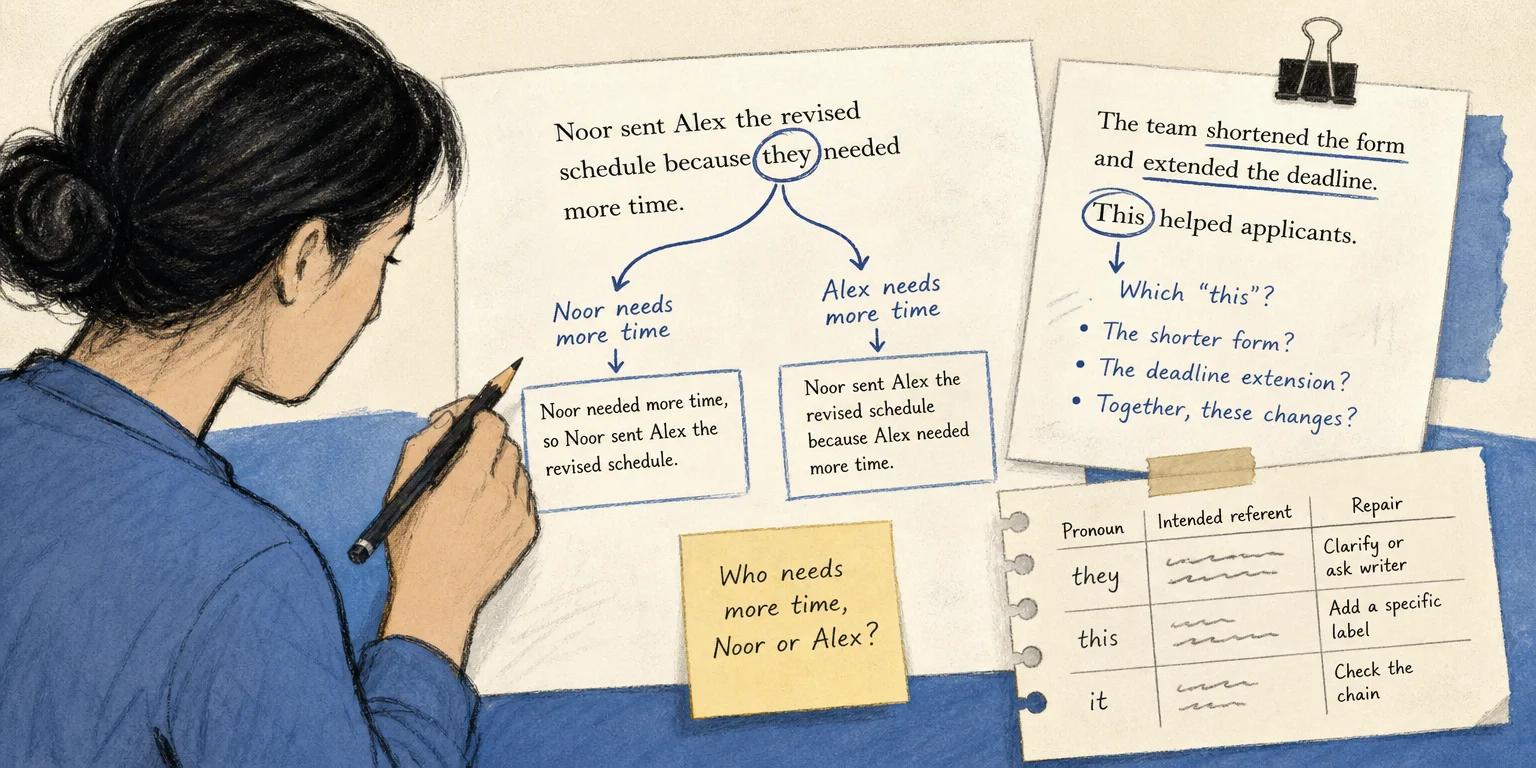
How to Fix Unclear Pronouns in AI Writing
Trace pronouns to their intended referents, test competing readings, and repair ambiguity without guessing what the writer meant.