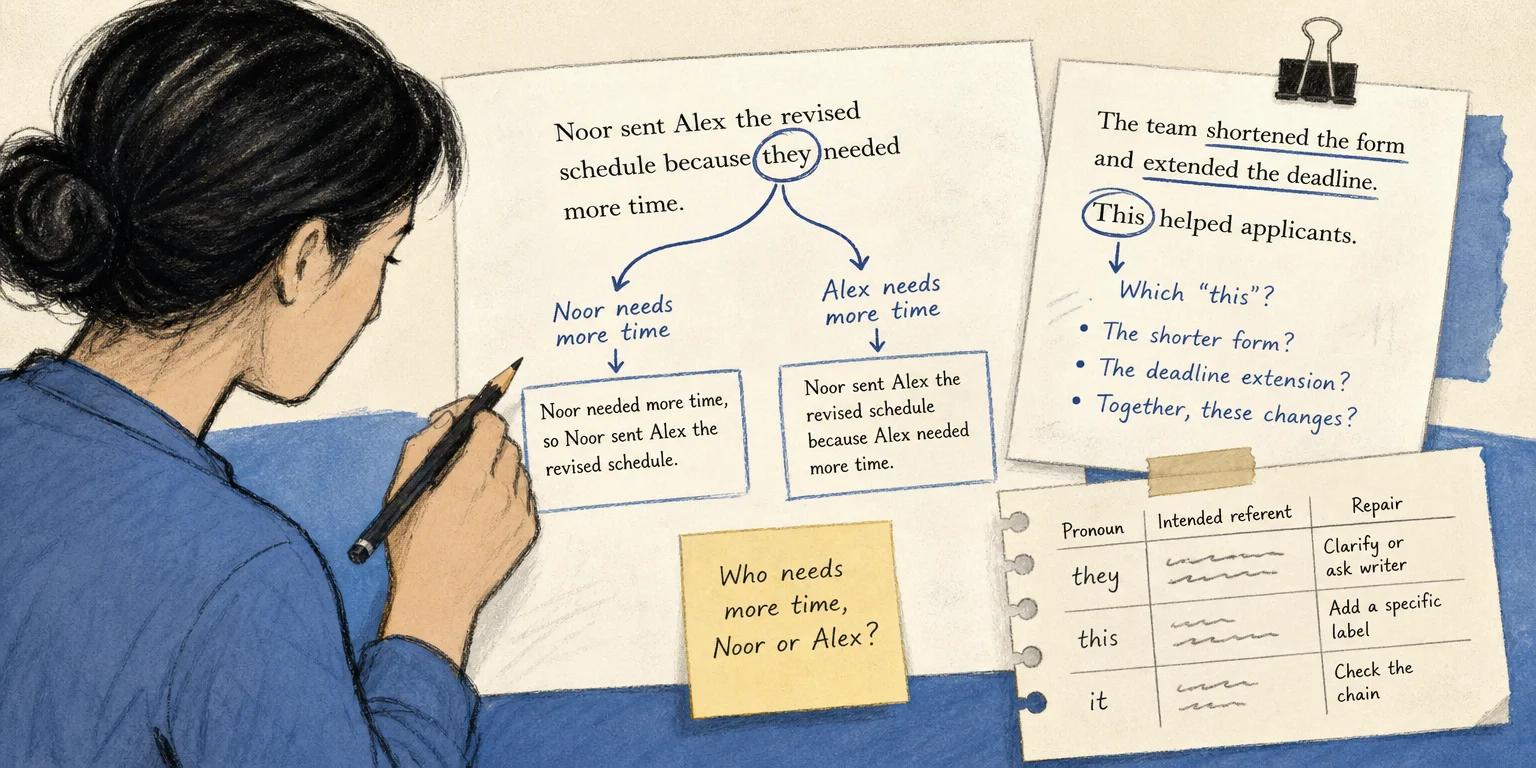
To fix unclear pronouns in AI writing, identify what each “it,” “they,” “this,” or “which” is meant to refer to. Check whether a reader could reasonably choose something else. Then name the intended person, object, or idea at the point of confusion. If the intended meaning is unknown, ask the writer instead of letting a rewrite choose it.
Find references worth checking
Read one paragraph with its preceding paragraph. Mark pronouns that refer backward, then connect each to its intended referent. The Writing Commons reference-checking exercise uses this kind of annotation to expose missing or competing antecedents.
Do not treat every marked word as an error. “It is raining” does not require the name of an object. Nor is singular “they” inherently unclear. The question is whether the reader can identify the intended person or thing in context.
Separate ambiguity from disagreement
A pronoun can agree grammatically and still be ambiguous. “The reviewer emailed the coordinator after they finished” leaves the responsible person unresolved even if singular “they” is appropriate for either person. Conversely, an agreement error can be repaired while leaving the wrong person in charge. Check identity before polishing grammar.
Test both plausible readings
Consider this invented teaching example:
Noor sent Alex the revised schedule because they needed more time.
The sentence could mean Noor needed more time or Alex needed more time. The editor cannot settle that from grammar alone.
| Intended meaning, confirmed by the writer | Possible revision |
|---|---|
| Noor needs more time | Noor needed more time, so Noor sent Alex the revised schedule. |
| Alex needs more time | Noor sent Alex the revised schedule because Alex needed more time. |
These versions say different things. A fluent AI suggestion is not evidence for choosing either. MLA's guide to pronouns and referents distinguishes multiple possible antecedents from missing or broadly stated references. That distinction helps decide whether you need a name, a noun phrase, or a clarification question.
Keep a question open when the source is unclear
In your editing notes, record the original sentence and the alternatives: “Who needs more time, Noor or Alex?” Leave the public-facing sentence unresolved until the writer answers. Do not insert a name merely because it is the nearest noun or seems most likely.
Give “this” a useful label
A sentence beginning with “This” may point to an entire preceding idea. Sometimes that is clear; sometimes two different events could be intended.
Here is another invented example:
The team shortened the form and extended the deadline. This helped applicants.
Does “this” mean the shorter form, the later deadline, or the combination? Possible labels include “The shorter form,” “The deadline extension,” or “Together, these changes.” Select one only after confirming what the writer means.
Adding a noun should clarify the reference without strengthening the claim. “This successful intervention” adds a positive judgment. “This policy failure” adds a negative one. Keep the label descriptive and check that the source supports the claimed effect. For a wider check, use the meaning-preserving editing workflow.
Check references after moving sentences
Reordering a paragraph can move a pronoun away from its referent or introduce a new competitor. After splitting a long sentence, confirm that the second sentence still identifies its subject. After moving a quotation, check whether “they” refers to the quoted speaker or to the surrounding discussion.
A useful three-column review note records the pronoun, the intended reference, and the repair. Include “ask writer” as a valid repair. This makes the uncertainty visible instead of burying it inside an apparently polished sentence.
Read beyond the edited line
Inspect the next sentence as well. Replacing one “it” with “the report” can leave a later “it” apparently referring to the report when it actually means the application. Check the chain, not just the first link.
Keep clear pronouns
Repeating every noun makes prose tiring and can obscure which items belong together. The VMI writing-center handout discusses both excessive pronouns and excessive repetition. Restore the noun where readers need it, then use a pronoun when the reference remains clear.
Do not use a readability score to decide whether an ambiguity is resolved. A short sentence can still have two readings. The guide to interpreting readability scores explains why a numerical signal cannot replace this reader-level check.
FAQs
Must “this” always be followed by a noun?
No. Add a label when the reference could be mistaken or when the reader would need to reconstruct too much context. Keep an already clear reference.
Can an AI editor identify the intended antecedent?
It can propose an interpretation. Confirm that interpretation against the draft, the underlying record, or the writer's answer before accepting a substantive change.
About Humanizer.help Editorial Team
The Humanizer.help editorial team writes practical AI writing guides for students, ESL writers, and academic drafts that need clearer, more natural English.
Related Articles
How to Humanize AI Text Without Changing the Meaning
A meaning-preservation workflow for students who want smoother AI-assisted writing without semantic drift.

How to Use Readability Scores When Editing AI Writing
Use readability scores to find dense AI-assisted prose, then make meaning-first edits and verify what readers can actually understand.