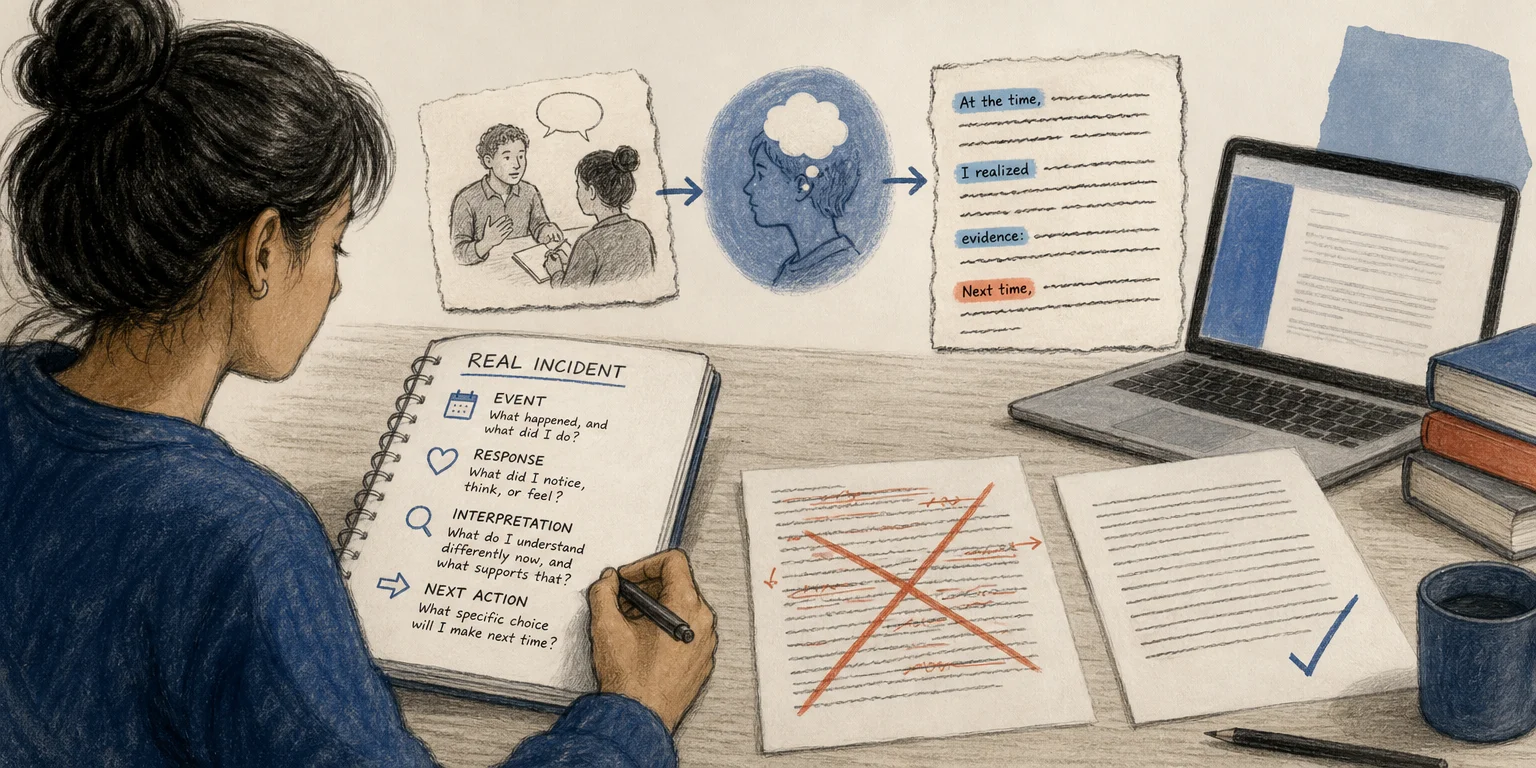
A reflective paragraph does more than report an event. It uses a real, bounded incident to explain what you learned, what supports that interpretation, and what you will do next. If the experience is yours, the details, feelings, feedback, and learning must also be yours. A writing tool can help you organize or clarify them, but it should not fill gaps with plausible-sounding experience.
Start with a record, not a polished story
Choose one incident you can reconstruct from memory and, where available, notes, drafts, messages, or feedback. Keep the scope small: one discussion, one revision decision, one attempt to apply a method, or one moment when your understanding changed.
Before drafting, make four short notes:
- Event: What happened, and what did you do?
- Response: What did you notice, think, or feel at the time?
- Interpretation: What do you understand differently now, and what supports that view?
- Next action: What specific choice will you make in a comparable situation?
Do not improve the story by adding feedback you never received, a feeling you do not remember, or a successful outcome that did not occur. Write “I do not have evidence that the change worked” if that limitation matters. Honest uncertainty can be part of reflection.
Keep description and reflection separate
Description gives the reader enough context to understand the incident. Reflection explains its significance. The University of Edinburgh’s structure guidance for academic reflections, published October 15, 2024, says reflective work should describe context, analyse it, and draw conclusions; it also cautions that there is no single required proportion for those parts. The assignment instructions take priority.
A useful drafting test is to label each sentence D for description or R for reflection. If every sentence is D, ask what the event changed in your understanding. If every sentence is R, add the concrete incident that makes the interpretation credible.
Illustrative example: notes to paragraph
The classroom incident below is invented teaching material. It is not a real student’s experience, feedback, or assessed result.
Invented notes
- Event: In a seminar exercise, the student summarized an article before stating why it mattered to the discussion.
- Response at the time: The student thought the summary was sufficient.
- Later interpretation: Comparing the summary with the prompt showed that it reported content but did not answer the prompt’s request for evaluation.
- Next action: Draft the evaluative point first, then select source details that support it.
Descriptive version
During an invented seminar exercise, I summarized the article’s main points. I explained the author’s examples and conclusion before moving to the next question.
This says what happened, but not what was learned.
Reflective version
During an invented seminar exercise, I summarized the article’s main points before explaining their relevance to the prompt. At the time, I treated an accurate summary as a complete response. When I compared my paragraph with the instruction to evaluate the author’s claim, I saw that I had reported the source without making a judgment about it. In a similar task, I would draft my evaluative point first and then choose source details that directly support or complicate that point.
The reflective version does not merely add emotion. It identifies an earlier assumption, names the evidence for the later interpretation, and turns the learning into a specific future action. In your own paragraph, replace every invented detail with your actual record.
Test the learning claim
A sentence such as “This taught me to communicate better” is too broad to inspect. Ask three questions: What changed in your understanding? What in the incident supports that conclusion? What would a reader see you do differently next time?
Your evidence may be the contrast between two drafts, an observation you recorded, feedback you can quote accurately, or your application of an assigned concept. Do not invent a course theory or citation to make the paragraph sound academic. Use theory only if the assignment requires it and you have read the source.
If you revise the English for clarity, preserve the terms and distinctions that carry your interpretation. The ESL voice-preservation checklist offers a separate final pass for clearer phrasing without replacing the writer’s idea.
Finish with an action you can recognize
Avoid endings such as “I will do better next time.” Name the situation, action, and check: “Before my next source-analysis paragraph, I will write one evaluative sentence and check that each quoted or paraphrased detail helps establish it.” This is a plan, not a claim that improvement has already happened.
Finally, compare the paragraph with the prompt, required reflective model, citation rules, and AI policy. No structure guarantees a grade. The paragraph is ready when its incident is real, its interpretation is supported, and its next step follows from the learning you can honestly claim.