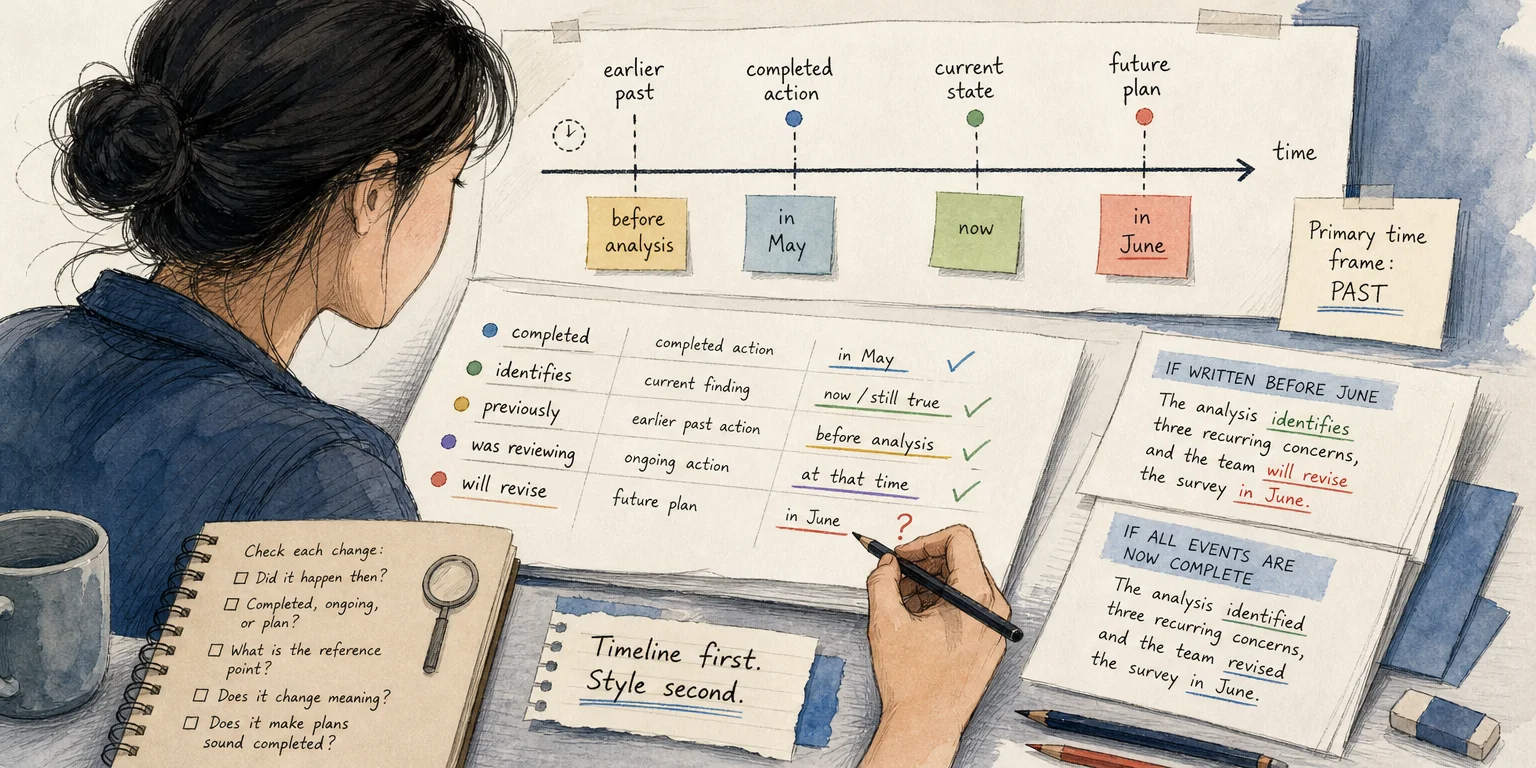
A sentence can contain more than one tense and still be correct. The real question is whether each verb matches the time of the action or state it describes. Before accepting an AI-assisted tense edit, map the timeline. Otherwise, a revision may make the grammar look uniform while changing what actually happened.
Start with time, not verb forms
Purdue OWL advises writers not to change tense when actions share a time frame, but to change tense when the time frame changes. It also recommends establishing a primary tense for the main discussion and using other tenses to show temporal relationships. That distinction is the basis of a reliable review: consistency does not mean forcing every verb into the same tense.
First, label the job of each statement:
- completed action;
- current state or general fact;
- action earlier than another past action;
- ongoing action;
- future plan or expected event.
Then choose a primary tense for the passage. A report of completed work will often use the past. A description of a current system may use the present. The primary tense gives readers an anchor, but it does not erase real changes in time.
Build a quick timeline
Copy the verbs from the passage into a small list. Beside each verb, write when its action occurs. Include time markers such as before, after, currently, last month, and next year. These markers often reveal whether a tense shift is necessary.
Use three checks:
- If two actions occur in the same time frame, unexplained tense changes are likely errors.
- If one action happened before another past action, the past perfect can clarify that earlier relationship.
- If the passage moves from a completed action to a current state or future plan, a tense change may be essential to the meaning.
Do not decide from one sentence alone. Purdue notes that perfect and progressive forms make the most sense in relation to the surrounding time frame. Read the sentence before and after each flagged verb.
Illustrative example: repair the timeline, not just the verbs
The following example is invented for teaching purposes.
Before:
The team completed the interview analysis in May. It identifies three recurring concerns and will revise the survey in June.
This passage mixes a completed analysis, a result that may still be current, and a future plan. The verb identifies is not automatically wrong. The writer must decide whether the finding remains a current claim. The date of the planned revision also matters.
Revision if the report was written before June:
The team completed the interview analysis in May. The analysis identifies three recurring concerns, and the team will revise the survey in June.
Revision if all events are now complete:
The team completed the interview analysis in May. The analysis identified three recurring concerns, and the team revised the survey in June.
The second revision would be inaccurate if the survey revision were still only planned. A tense edit must never convert an intention into a completed action.
Review AI-assisted changes one verb at a time
When a tool suggests making every verb past or present, compare the suggestion with your timeline. For each changed verb, ask:
- Did the action actually happen at that time?
- Is this a completed event, an ongoing state, or a plan?
- Does another event provide the reference point?
- Did the edit remove a useful distinction between then and now?
- Did the edit make an uncertain or future event sound completed?
Accept only changes you can explain from the passage's meaning. If the original timeline is unclear, resolve the factual sequence before polishing the prose. Grammar cannot supply missing facts.
Separate tense repair from style editing
Complete the timeline pass before improving rhythm, transitions, or sentence variety. Style edits can move clauses, remove time markers, or combine sentences, making the sequence harder to verify. Lock the temporal meaning first; then make the prose smoother without changing it.
Writers working across languages may also want the broader guide to clear AI-assisted ESL writing without erasing the writer's voice. Its task is general clarity and voice preservation; the workflow here is narrower and focuses on temporal meaning.
Final tense-consistency check
Before finishing, confirm that the passage has a clear primary time frame, every shift corresponds to a real change in time, earlier past events are distinguishable where needed, and plans remain plans. Read the passage once for chronology without judging its style. If you can place every action on the timeline and explain every tense shift, the grammar is serving the meaning.
Source note: Purdue OWL, “Verb Tense Consistency,” accessed November 16, 2026: https://owl.purdue.edu/owl/general_writing/grammar/verb_tenses/verb_tense_consistency.html.