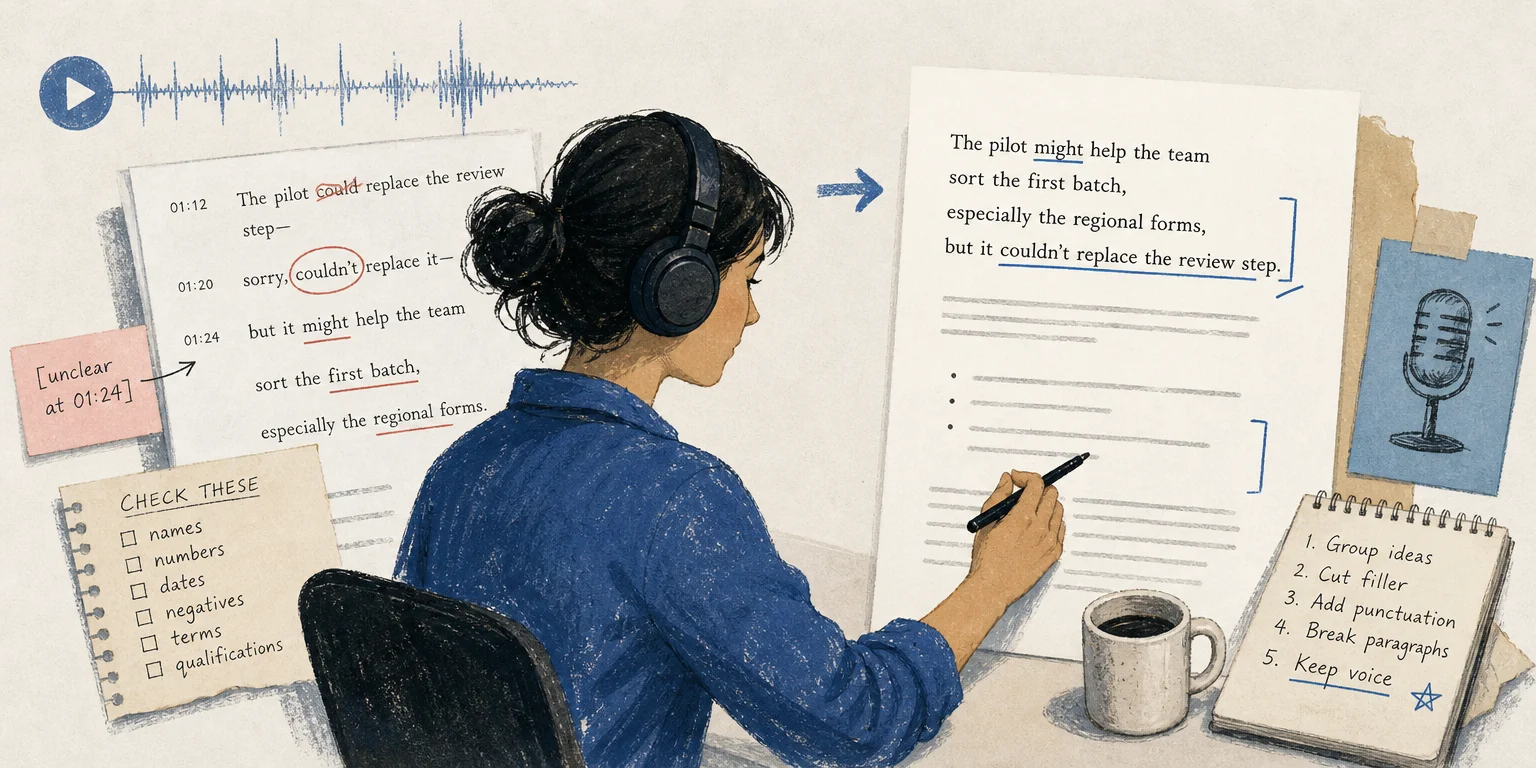
A dictated draft can contain two different problems. The transcript may include words the speaker never said, while the draft itself may still need clearer structure and smoother prose. Treating both as one rewriting job is risky: a polished sentence can hide a transcription mistake.
The safer order is simple: repair the transcript first, then edit the writing.
Pass 1: establish what was actually said
Keep the recording and raw transcript together. During this pass, do not improve the argument or make the language more elegant. Your job is to recover the intended words.
Mark anything that could change meaning: names, numbers, dates, negatives, technical terms, comparisons, and qualifications such as may, usually, or in this case. Replay the relevant audio. If it remains unclear, ask the speaker rather than choosing the most plausible word. When confirmation is unavailable, leave a marker such as [unclear at 01:24].
This is not ordinary proofreading. Changing can to cannot, or fifteen to fifty, changes the statement itself. Later style editing cannot silently repair that error.
Google's voice-typing help says a writer can move the cursor to a mistake and correct it without turning off the microphone; it also says alternatives may be suggested for some words. The page had no publication date in the supplied evidence and was manually verified on November 13, 2026: Type and edit with your voice. This establishes a bounded correction capability, not the accuracy of any transcript.
Pass 2: turn reliable words into readable prose
Once the transcript is reliable, make editorial choices. Spoken language often contains restarts, repeated context, filler, and sentences whose structure becomes clear only at the end. A Grammarly product article published June 15, 2026 describes raw mobile dictation as containing filler words, false starts, and missing punctuation: Say It, Then Send It with Speech to Text. Its statements about Grammarly's own processing are vendor claims, not independent evidence that this workflow improves outcomes.
Write a one-sentence statement of the speaker's main point. Then:
- Group sentences that belong to the same idea.
- Remove genuine false starts and repetitions, but keep repetition that adds emphasis.
- Add punctuation and paragraph breaks.
- Remove filler only when it carries no hesitation or stance the reader needs.
- Preserve the speaker's certainty, terminology, and recognizable phrasing.
For a broader meaning-preservation check, see how to humanize text without changing its meaning.
Illustrative example: correction before style
The following example is invented for teaching. It is not a real transcript or product test.
Raw transcript: “The pilot could replace the review step—sorry, couldn't replace it—but it might help the team sort the first batch, especially the regional forms.”
Transcript repair: “The pilot couldn't replace the review step, but it might help the team sort the first batch, especially the regional forms.”
The repair removes a self-correction while preserving couldn't, might, first batch, and regional forms. Those details define the claim.
Style revision: “The pilot might help the team sort the first batch, especially the regional forms, but it couldn't replace the review step.”
The revision puts the possible benefit first and the boundary last. It is easier to scan, but it does not strengthen might into will or delete the review requirement. Keeping the limitation first would also be valid if that emphasis reflects the speaker's intent. Voice is partly a choice about emphasis, not just vocabulary.
Run two separate checks
For transcript accuracy, compare every marked span with the recording or the speaker. Confirm names, figures, negatives, and specialized terms. Do not resolve uncertainty from context alone.
For editorial accuracy, compare the revised prose with the repaired transcript. Ask whether any claim became stronger, any condition disappeared, or any emphasis moved. Read the revision aloud. If it no longer sounds like the speaker, restore characteristic wording where clarity allows. If the draft contains external claims, use a separate fact-checking workflow; transcript fidelity does not prove factual accuracy.
A clean draft is not necessarily a faithful draft. Repairing recognition errors before editing style keeps uncertainty visible and gives every later revision a dependable source text.
About Humanizer.help Editorial
Related Articles

How to Humanize AI Text Without Changing the Meaning
A meaning-preservation workflow for students who want smoother AI-assisted writing without semantic drift.

How to Fact-Check AI-Generated Text Before You Use It
Use a source-first workflow to verify claims, citations, quotations, dates, and numbers in AI-assisted drafts before publishing or submitting them.