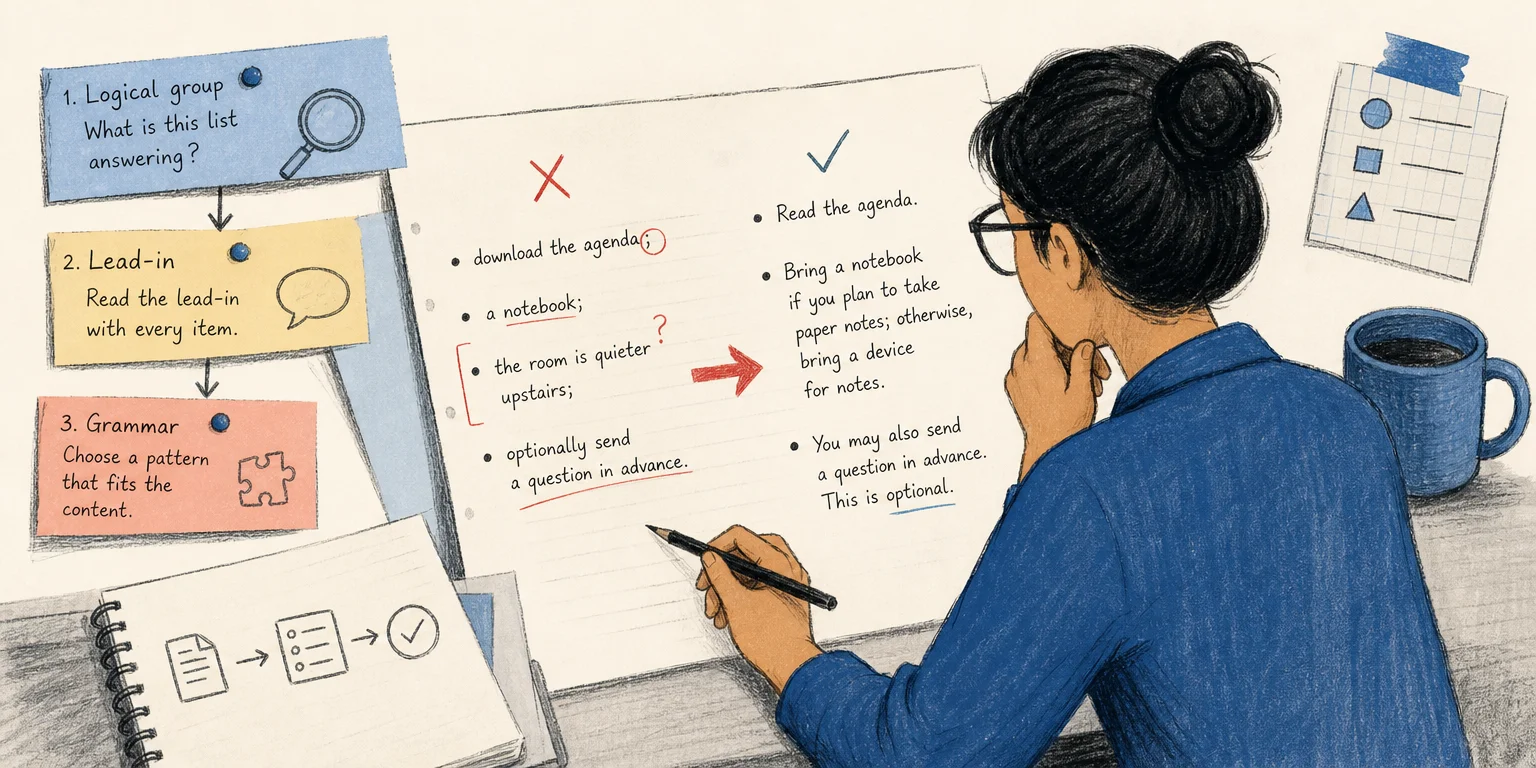
To fix parallel structure in AI-generated lists, check that every item completes the same lead-in and belongs to the same logical group. Then choose a matching grammatical form without changing who acts, when a condition applies, or whether an item is optional. Matching the first word of every bullet is not enough.
A list can look tidy while mixing a task, a benefit and a warning. Turning all three into commands may improve its appearance while changing its meaning. Start by deciding what the list is actually listing.
Give the list one organizing question
Read the introduction and ask what kind of answer each bullet supplies. Are these materials to bring, actions to take, reasons to choose something, or outcomes to expect? Write that category in a short note.
Google's technical-writing lesson on lists separates grammatical consistency from consistency of logical category. Both matter. “A printed ticket,” “a photo ID” and “a shorter queue” are all noun phrases, but a shorter queue is not another document to bring.
Move an item that answers a different question into a sentence or a separately introduced list. Do not invent another requirement to make the existing bullets look balanced. If the categories are unclear, return to the writer's source notes before rewriting.
Read the lead-in with every item
A partial lead-in and a bullet together form a grammatical unit. Read them aloud as a single sentence. “The review includes checking the dates” works; “The review includes verify the names” does not.
The Australian Government Style Manual on lists recommends matching the grammatical structure of items and their lead-in. You can repair a mismatch by changing the lead-in, changing the items, or making each item a complete sentence. Choose the version that makes the relationship easiest to understand.
Choose a pattern that fits the content
For a list of things, noun phrases may work: “a notebook,” “a printed agenda,” “a reusable cup.” For actions, imperative verbs may work: “Read the agenda,” “Check the venue,” “Bring a notebook.” These are different promises to the reader, not interchangeable formatting choices.
Purdue OWL's parallel-structure guide explains parallelism at the word, phrase and clause levels. Items do not need identical length or the same opening verb. They need a compatible construction that reflects their role.
Repair shared wording carefully
If every bullet repeats “by,” it may fit in the lead-in. But read the result with each item again. Moving a shared verb or qualifier can unintentionally make it govern an item that originally had a different condition or level of obligation.
Do not remove a repeated word merely because it repeats. The guide to removing repetition from AI writing distinguishes useful repetition from redundant meaning. In a short list, repetition can make a relationship clearer.
Separate grammar problems from content problems
Try two passes. First label the role of each item without editing its words. Then inspect its grammatical construction. This avoids solving a content mismatch with a cosmetic rewrite.
Consider these invented bullets under “Before the session, you must”:
- download the agenda;
- a notebook;
- the room is quieter upstairs;
- optionally send a question in advance.
The notebook item lacks an action. The room note is information about the venue. The final item conflicts with the mandatory lead-in because it is explicitly optional. Converting everything to a matching verb would not resolve those differences.
The source notes would need to establish whether the notebook is required and whether the upstairs room is actually relevant. The example is a grammar exercise, not a description of a real event or service.
Work through a repair that protects exceptions
Here is a complete fictional brief: participants must read a supplied agenda before a workshop. They must bring a notebook if they want to take paper notes; otherwise, a device for notes is acceptable. They may send a question in advance, but it is optional. There is no required action concerning the room.
An over-normalized rewrite might say:
Before the workshop, read the agenda, bring a notebook, and send a question.
Those verbs are parallel, but the sentence turns a conditional material choice and an optional contribution into universal instructions. A better version separates the relationships:
Before the workshop:
- Read the agenda.
- If you choose to take notes, bring a notebook for paper notes or use a device. Taking notes is optional.
You may also send a question in advance. This is optional.
The longer second bullet is acceptable because it preserves a meaningful condition. We removed the room note because the fictional brief supplied no relevant instruction, not because every list must contain exactly two bullets. Another valid repair could give the note-taking choice its own short paragraph.
Keep order and obligation visible
Use numbering when the order is meaningful, such as a sequence of steps. Use bullets for an unordered set. Microsoft's list guidance makes this distinction; it also recommends consistent item structure.
A list's appearance cannot establish whether all items are required, any one is sufficient, or the list is only illustrative. State that relationship in the lead-in when it matters. Preserve “and,” “or,” “for example,” and qualifying conditions according to the intended meaning. For formal requirements, verify the governing document rather than treating a punctuation choice as an authority to change the rule.
Before accepting an AI rewrite, compare the original relationships with the new version using the meaning-preserving editing checklist. Check the actor, required action, sequence, alternatives and exceptions separately.
Finish with formatting after the meaning is stable
Apply your publication's conventions for capitalization and punctuation. Style guides differ, so avoid combining fragments from several guides into a supposed universal rule. Use consistent treatment for comparable items, then inspect the rendered page to confirm the bullets or numbers remain a real list.
The review is complete when every item answers the organizing question, works with its lead-in, and retains its original conditions. If an item cannot pass those checks, revise the structure or ask the writer for a decision instead of forcing it into the pattern.
FAQs
Must every bullet begin with the same word?
No. Items can use different verbs or nouns while sharing a grammatical form. Repeating the same word may be useful, but it does not prove the items belong in the same list.
Is a grammatically parallel list always clear?
No. Matching noun phrases can still mix materials, actions and benefits. Check the logical category and the list's relationship to its lead-in as well as the grammar.
Can I make an optional item match a required list?
You can rephrase it only while keeping its optional status explicit. Often it is clearer to move it outside the required list. Never delete an exception simply to make the bullets uniform.
About Humanizer.help Editorial Team
The Humanizer.help editorial team writes practical AI writing guides for students, ESL writers, and academic drafts that need clearer, more natural English.
Related Articles

How to Remove Repetition from AI Writing Without Making It Choppy
Find repeated ideas, merge redundant paragraphs, vary sentence patterns, and preserve the transitions that keep AI-assisted writing coherent.

How to Humanize AI Text Without Changing the Meaning
A meaning-preservation workflow for students who want smoother AI-assisted writing without semantic drift.