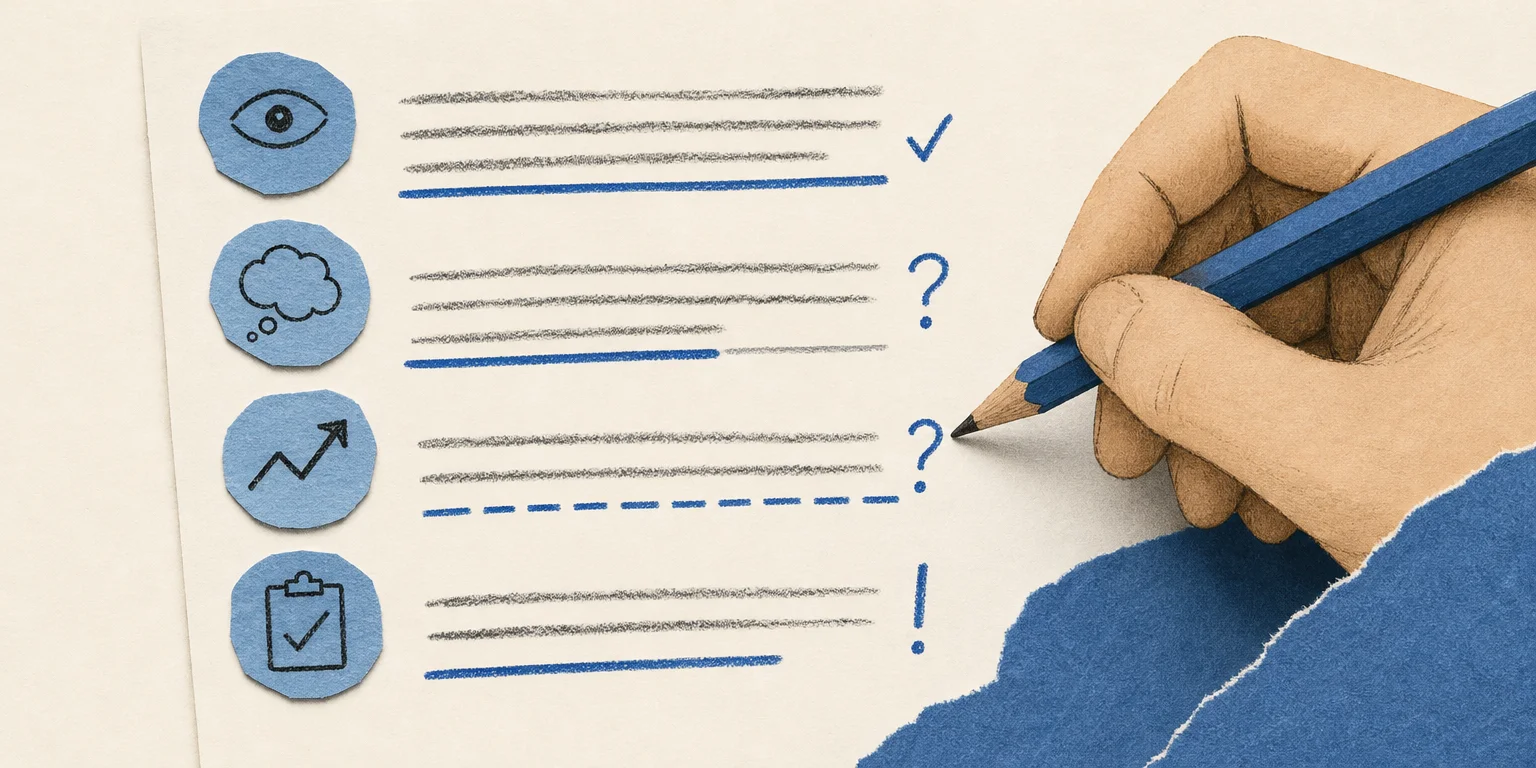
To edit certainty in AI writing, classify each statement before changing its tone. Report verified observations directly, qualify interpretations where the evidence is limited, and keep real requirements explicit. Adding “may” to every sentence can be as misleading as deleting every qualification.
Separate four kinds of statements
Mark whether a sentence reports an observation, offers an interpretation, predicts an outcome, or states a requirement. These jobs need different wording. An attendance count is not a theory about attendance. A registration rule is not a forecast about what people might do.
The Oxford guide to hedging explains how cautious language manages claim strength and warns against indiscriminate hedging. Use caution where it communicates an actual limit, rather than as a general academic tone.
Record what is uncertain
Write the uncertainty in ordinary words before choosing a hedge. Is the number approximate? Is the cause unknown? Does the finding apply only to a particular group? Is a future outcome contingent on an event? “Maybe” does not tell readers which of those limits applies.
Work through a mixed-certainty paragraph
This is an invented teaching fixture, not research or a product test. Imagine verified workshop records show 24 attendees, an optional feedback form, 15 returned forms, and 11 positive ratings. No question measured learning, and no comparison group was used.
An overconfident draft says:
All attendees loved the workshop, which proved that the new format improves learning.
A mechanically cautious revision says:
There may have been 24 attendees, who possibly completed 15 forms, and the workshop may perhaps improve learning.
The second version weakens verified counts while retaining an unsupported learning claim. A better paragraph separates what the records establish from what remains unknown:
Twenty-four people attended the workshop. Fifteen returned feedback forms, and 11 of those respondents gave a positive rating. These responses describe respondent satisfaction; they do not establish whether the format improved learning.
Choose the repair for each claim
| Statement | Evidence status | Editorial decision |
|---|---|---|
| 24 people attended | Verified attendance record | State the count directly. |
| All attendees loved it | Only 15 responses, 11 positive | Name the responding group and actual result. |
| The format improved learning | Learning was not measured | Remove the claim; do not disguise it with “may.” |
| The format could be studied further | A proposed next step | Identify it as a proposal, not a result. |
This is a calibration exercise after the sources have been checked. If the count or source itself is doubtful, use the fact-checking workflow for AI-generated text first.
Put the qualification on the right part
Compare “The estimate is approximately 40” with “The estimate probably explains the outcome.” The first qualifies precision; the second qualifies an explanation. They are not interchangeable.
Monash's cautious-language guidance illustrates how reporting verbs, modal verbs and other qualifiers change a claim. Choose wording that names the actual limitation: “in this sample,” “based on the available responses,” or “one possible explanation.” Avoid stacking several vague modifiers when one precise boundary is clearer.
Do not turn possibility into a numerical probability
Words such as “may,” “likely,” and “suggests” do not supply a universal numerical confidence scale. Do not invent a probability because a sentence sounds cautious. If a source reports an interval or probability, preserve its actual definition and context.
Keep obligations and permissions intact
If an approved procedure requires a receipt, “You may need a receipt” can incorrectly turn the requirement into uncertainty. If the policy allows an optional step, “You must complete it” introduces an obligation.
Check the governing record before changing “must,” “can,” or “may.” In one context “may” expresses permission; in another it expresses possibility. Label the function in your notes. Style preferences cannot decide whether an action is required.
For these changes, the meaning-preserving editing checklist provides a useful second pass. Compare the final wording with the source, not only with the previous draft.
Remove unsupported claims instead of cushioning them
“An unknown method might double productivity” is still a claim about a particular method and outcome. A hedge does not create evidence. When the source does not support a useful proposition, delete it or replace it with an explicit question for investigation.
The Edinburgh postgraduate writing materials distinguish overstated claims from claims without support. That difference matters: narrowing a supported interpretation and removing an unfounded assertion are different editorial actions.
Finish with a certainty map
For each consequential sentence, record its job, supporting source, exact uncertainty, and final wording. Read the paragraph without markup. Verified observations should remain visible; interpretations should not masquerade as measurements; requirements should still tell the reader what to do.
FAQs
Does formal writing require hedging every statement?
No. Use it strategically where evidence, scope, interpretation or prediction requires qualification. Over-hedging can obscure what is actually known.
Can changing “proves” to “suggests” fix any claim?
No. The source must still support the narrower proposition. A different verb cannot repair invented evidence or an outcome that was never measured.
About Humanizer.help Editorial Team
The Humanizer.help editorial team writes practical AI writing guides for students, ESL writers, and academic drafts that need clearer, more natural English.
Related Articles

How to Fact-Check AI-Generated Text Before You Use It
Use a source-first workflow to verify claims, citations, quotations, dates, and numbers in AI-assisted drafts before publishing or submitting them.

How to Humanize AI Text Without Changing the Meaning
A meaning-preservation workflow for students who want smoother AI-assisted writing without semantic drift.