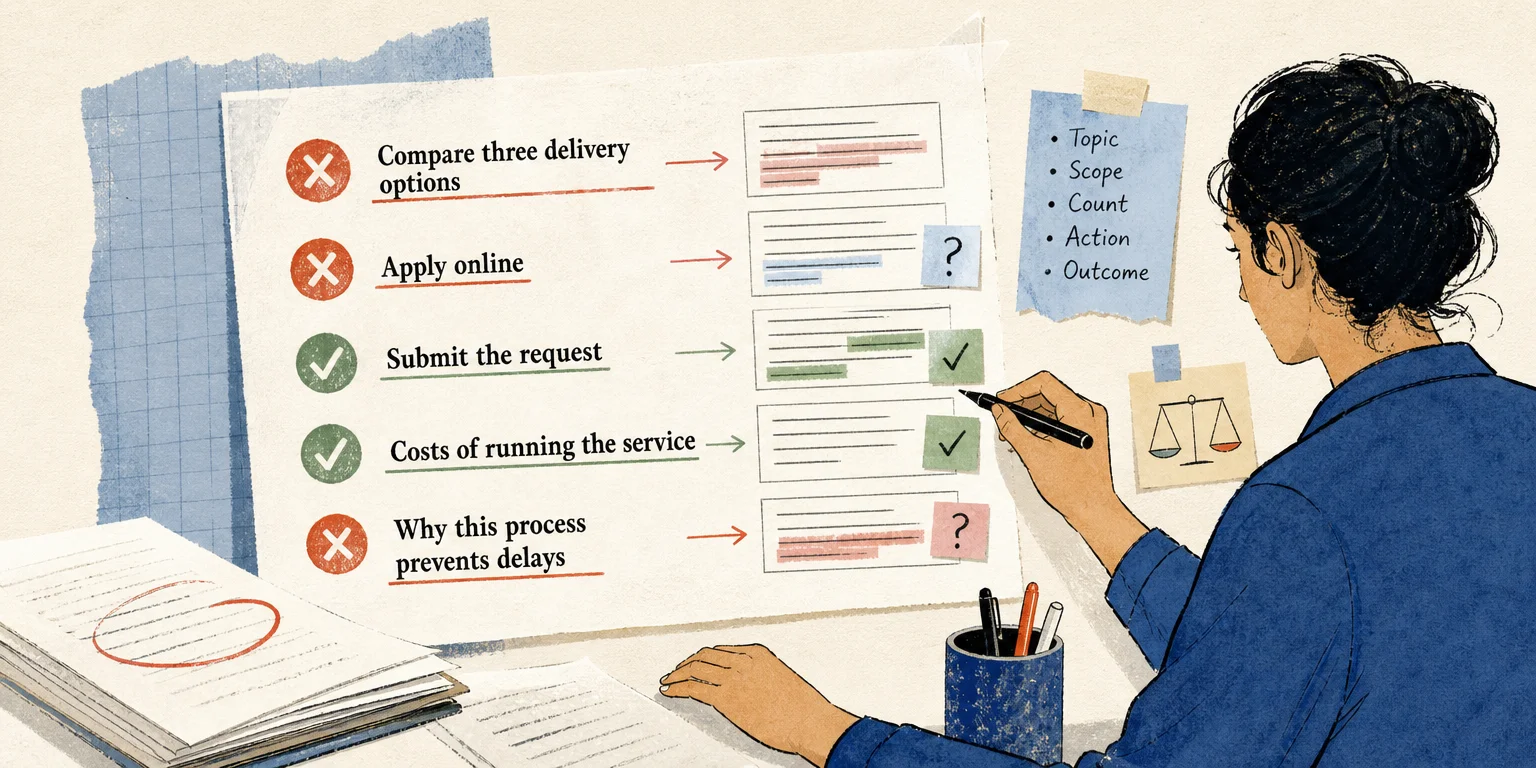
To check AI-generated headings against the content, turn each heading into a promise and point to the passage that fulfills it. Check the promised topic, scope, number of items, action and strength of conclusion. If the section cannot deliver, narrow the heading or add the missing, verified material before publication.
A heading can sound precise while introducing the wrong section. “Compare three delivery options” fails if the text describes only two. “Apply online” overpromises if the section merely explains who is eligible. Polishing those phrases does not fix the missing answer.
Start with the promise, not the wording
For each heading, finish this sentence: “After this section, the reader will know or be able to…” Then underline the exact sentences, list or table that provide that answer. An outline alone cannot establish the match; read the section beneath it, including any notes that restrict its scope.
The W3C explanation of headings and labels distinguishes accurately describing a topic or purpose from the separate issue of marking up headings correctly. This audit addresses the content match. It does not establish that an entire page meets an accessibility standard.
Write a short note for each mismatch: the heading, its promise, the supporting passage and the missing element. “The comparison omits the third option” is actionable. “This heading feels generic” leaves the actual problem unresolved.
Check five kinds of mismatch
Topic and scope
A section headed “Costs of running the service” needs more than the initial subscription price if readers would reasonably expect ongoing charges. If the draft only has confirmed subscription details, “Subscription price” is a more defensible heading. Do not add estimates for support, tax or maintenance merely to fill the broader label.
Check limiting words too: “all,” “complete,” “every” and “only” each expand or restrict what the section must establish. Replace them when the content does not justify them. A bounded heading can be useful without pretending to cover every case.
Counts and comparison sets
Count the actual entries, then check that they belong to the promised category. A paragraph that names three services is not necessarily a comparison of three services. A comparison needs relevant points of comparison; a list of names may only support an overview.
Use the same criteria across the items when the heading promises a comparison. If information about one option is unavailable, say what is missing or reduce the claim. Do not invent a feature, price or test result to make a table look balanced.
Actions and outcomes
A task heading such as “Submit the request” implies actionable instructions. Can a reader identify where to start, what information is needed and how to complete the stated action from this section? An eligibility explanation might instead need “Who can submit a request.”
Google's guidance on headings distinguishes task-oriented headings from conceptual headings. Its conventions belong to its documentation style; the useful editing question here is whether the section supplies a procedure or an explanation. Choose the promise that the available content can fulfill.
An outcome heading needs a separate evidence check. “Why this process prevents delays” makes a stronger claim than “Steps intended to reduce delays.” Neither wording is justified simply because the draft sounds confident. Use the fact-checking workflow for AI-generated text to verify the underlying assertion before deciding how strongly to label it.
Work through a small example
The following is an invented editing example, not a report about a real service or a user test.
Draft heading: “Compare all three submission methods.” The section explains email and a web form. A closing sentence says that postal submission exists but gives no details.
Audit note: the heading promises a complete comparison of three methods. The body supplies descriptions of two methods and a mention of the third. It lacks comparison criteria and information about postal submission.
If the purpose is to explain the two documented routes, change the heading to “Email and web form submission options,” and retain a clear note that the section does not cover postal submission. If readers actually need to choose among three methods, obtain reliable details for the third and compare the relevant criteria. Relabeling alone cannot complete that reader task.
This decision has two valid paths because the page's intended job matters. The audit should expose the choice rather than automatically produce a narrower heading for every gap.
Choose whether to revise the heading or the section
Revise the heading when the existing section already answers a useful, appropriately bounded question. Keep the important topic early and use wording that identifies the answer readers will find. The Australian Government guidance on headings supports using headings to communicate a section's topic and help readers find information.
Revise the section when its promised answer is necessary to the page's purpose and you can supply verified material. Add the actual missing step, definition or comparison, then check the heading again. If evidence cannot be obtained, disclose the gap or defer the section; do not hide it behind a broader label.
For a heading copied from an earlier draft, check whether later deletions or reordered paragraphs removed its answer. Conversely, a new section may have expanded beyond its old heading. Match both directions: each heading needs its answer, and each important answer needs an appropriate place in the outline.
Run the outline check after the content check
Read the headings alone once the promises are accurate. They should form a useful route through the page. Use the guide to descriptive headings and navigation for that next pass, including logical levels and findability. Keep the content audit separate in your notes so that an attractive outline does not conceal an unanswered promise.
Then read each heading with its opening paragraph. A sentence saying “This section covers three methods” is another promise, not proof that three methods are covered. Inspect the whole section before marking it complete.
Questions that come up during review
Should every heading be a question?
No. A question works when the section answers it directly. A task phrase, topic label or comparison heading can also work. Choose the form that reflects the section's actual purpose, then check that the answer or action is present.
Can I fix a mismatch by making the heading vague?
Only if the revised heading still tells readers what they will find. “Useful information” may stop making a specific promise, but it does little to help a reader choose whether to read the section. Prefer an accurate, concrete boundary such as “Documents needed for the application.”
Does a heading audit prove the facts are correct?
No. A heading and body can agree while both contain an unsupported claim. Verify factual assertions separately, then check that the heading accurately represents the evidence and limitations in the section.
About Humanizer.help Editorial Team
The Humanizer.help editorial team writes practical AI writing guides for students, ESL writers, and academic drafts that need clearer, more natural English.
Related Articles

How to Fact-Check AI-Generated Text Before You Use It
Use a source-first workflow to verify claims, citations, quotations, dates, and numbers in AI-assisted drafts before publishing or submitting them.

How to Edit AI-Generated Text for Screen Reader Navigation
Review AI-assisted articles for descriptive headings, clear link text, meaningful reading order, and the final structure readers will navigate.